US Data Privacy Laws: Reshaping Digital Marketing for Q3 2026
The digital marketing world is in a constant state of flux, driven by technological advancements, evolving consumer behaviors, and, increasingly, by stringent regulatory frameworks. As we approach Q3 2026, the impact of US data privacy laws on digital marketing strategies is not just a ripple; it’s a tidal wave reshaping how businesses connect with their audiences. Understanding these changes is paramount for any organization aiming to thrive in the modern digital landscape. The era of unrestricted data collection and usage is steadily fading, replaced by a more privacy-centric paradigm that demands transparency, consent, and accountability from marketers.
For years, digital marketers have leveraged vast amounts of consumer data to craft highly targeted campaigns, personalize experiences, and optimize conversions. This data-driven approach, while incredibly effective, has also raised significant concerns about individual privacy. In response, both federal and state governments across the United States have been actively enacting and refining data privacy legislation, creating a complex web of regulations that businesses must navigate. This article will delve deep into how these US data privacy marketing laws are fundamentally altering the digital marketing ecosystem, offering insights and actionable strategies for businesses to adapt and succeed in Q3 2026 and beyond.
The shift towards greater data privacy is not merely a legal obligation; it’s a fundamental change in consumer expectations. Today’s consumers are more aware than ever of the value of their personal data and are increasingly demanding greater control over how it is collected, used, and shared. Businesses that embrace this shift, prioritizing privacy by design and building trust with their audience, are more likely to foster long-term relationships and brand loyalty. Conversely, those that fail to adapt risk not only hefty fines and legal battles but also significant damage to their brand reputation.
This comprehensive guide will cover the key data privacy laws influencing US data privacy marketing, explore their implications for various marketing channels, and provide practical advice on how to develop compliant and effective digital marketing strategies for Q3 2026. From understanding the nuances of consent management to re-evaluating data collection practices and embracing privacy-enhancing technologies, we will equip you with the knowledge needed to navigate this evolving regulatory environment successfully.
The Evolving Landscape of US Data Privacy Laws: A Q3 2026 Perspective
The United States, unlike the European Union with its unified GDPR, has a patchwork of sector-specific and state-level data privacy laws. This creates a complex and often challenging environment for businesses operating nationally. As we look towards Q3 2026, several key legislative developments continue to shape the US data privacy marketing landscape.
Federal Initiatives and the Call for a National Standard
While a comprehensive federal data privacy law akin to GDPR has yet to pass, discussions and proposals are ongoing. The American Data Privacy and Protection Act (ADPPA), though stalled, represents a significant attempt to establish a national standard. Should such a law be enacted, it would undoubtedly simplify compliance for businesses by preempting many state-specific regulations. However, until then, companies must continue to monitor and comply with individual state laws.
The Federal Trade Commission (FTC) also plays a crucial role, enforcing existing privacy laws and bringing actions against companies engaged in deceptive or unfair data practices. Their increased focus on data security and privacy practices means businesses must be proactive in their compliance efforts, not just reactive. The FTC’s guidance and enforcement actions often set precedents that influence broader industry practices.
Key State-Level Laws and Their Impact
The most significant drivers of change in US data privacy marketing have been state-level laws. The California Consumer Privacy Act (CCPA) and its successor, the California Privacy Rights Act (CPRA), set a high bar for consumer data rights. These laws grant consumers the right to know what personal information is collected about them, the right to delete that information, and the right to opt out of the sale or sharing of their personal information. For marketers, this means re-evaluating how data is collected, stored, and used for advertising purposes, particularly concerning targeted advertising and cross-context behavioral advertising.
Beyond California, other states have followed suit, introducing their own comprehensive privacy laws. States like Virginia (Virginia Consumer Data Protection Act – VCDPA), Colorado (Colorado Privacy Act – CPA), Utah (Utah Consumer Privacy Act – UCPA), and Connecticut (Connecticut Data Privacy Act – CTDPA) have enacted similar, though not identical, legislation. Each of these laws has its own specific requirements regarding consumer rights, data processing agreements, and consent mechanisms. The proliferation of these state laws necessitates a robust and adaptable compliance framework for any business engaged in US data privacy marketing.
As of Q3 2026, we can anticipate more states to introduce or pass similar legislation, further complicating the compliance landscape. This necessitates a proactive approach to understanding the nuances of each law and implementing strategies that can accommodate varied requirements without sacrificing marketing effectiveness.
Implications for Digital Marketing Channels and Strategies
The evolving data privacy landscape has profound implications across all digital marketing channels. Marketers can no longer rely on traditional data collection and targeting methods without careful consideration of compliance and consumer consent. This section explores the specific impacts on various marketing strategies and offers guidance for adaptation.
Rethinking Data Collection and Usage
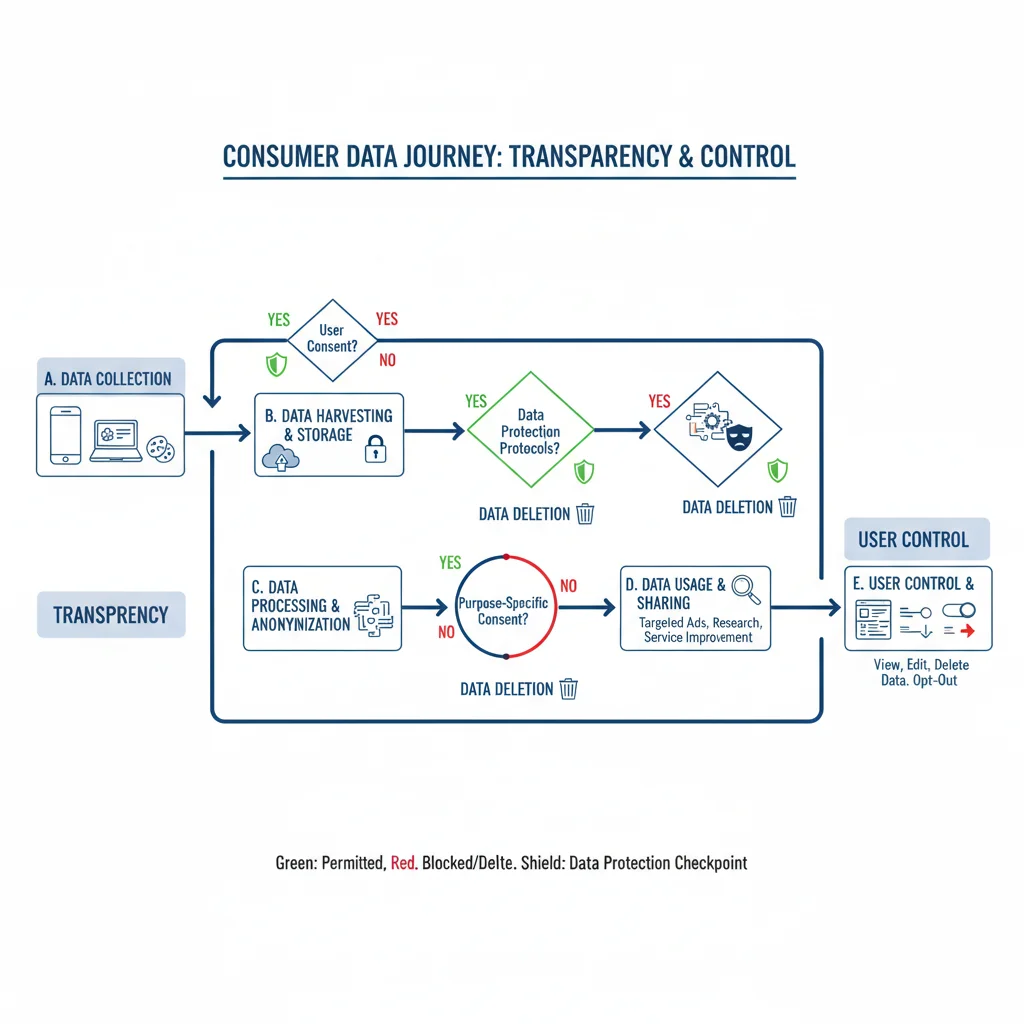
At the core of data privacy laws is the principle of consent and transparency. For US data privacy marketing, this means a significant shift in how businesses collect and utilize consumer data. Explicit consent, often requiring opt-in mechanisms, is becoming the standard, moving away from implied consent or pre-checked boxes. Marketers must clearly articulate what data they are collecting, why they are collecting it, and how it will be used. This transparency builds trust and empowers consumers.
- First-Party Data Strategy: The value of first-party data (data collected directly from your customers with their consent) is skyrocketing. Businesses should prioritize building robust first-party data strategies, including loyalty programs, direct customer interactions, and consented email sign-ups. This data, when collected ethically and transparently, offers a sustainable and compliant foundation for marketing efforts.
- Data Minimization: Collect only the data that is necessary for a specific purpose. This principle, enshrined in many privacy laws, reduces risk and simplifies compliance. Regularly audit your data collection practices to ensure you are not gathering superfluous information.
- Data Governance and Management: Implement strong data governance policies, including clear data retention schedules, secure storage, and access controls. Knowing where your data resides and who has access to it is crucial for demonstrating compliance and responding to consumer rights requests.
Impact on Targeted Advertising and Personalization
Targeted advertising, which relies heavily on third-party cookies and cross-site tracking, is arguably the most affected area. The deprecation of third-party cookies by major browsers like Chrome, combined with privacy regulations, is forcing marketers to rethink their targeting strategies.
- Contextual Advertising: This traditional method is making a comeback. By placing ads on websites or content relevant to the product or service, marketers can reach interested audiences without relying on personal data.
- Privacy-Enhancing Technologies (PETs): Explore new technologies and frameworks being developed to enable privacy-preserving advertising. These include Google’s Privacy Sandbox initiatives, federated learning, and secure data clean rooms, which allow for insights to be derived from aggregated, anonymized data without exposing individual user information.
- Identity Resolution: Invest in privacy-compliant identity resolution solutions that can unify customer data across different touchpoints using consented first-party identifiers, rather than relying on third-party cookies.
- Personalization with Consent: Personalization remains vital, but it must be executed with explicit consent and transparency. Leverage consented first-party data to personalize experiences on your owned properties (website, app, email) rather than relying on broad, untargeted third-party data.
Email Marketing and SMS Compliance
Email and SMS marketing remain powerful tools, but they are also subject to strict consent requirements under various privacy laws, including CAN-SPAM, TCPA, and state-specific regulations. For US data privacy marketing, adherence to these rules is non-negotiable.
- Clear Opt-In: Ensure all subscribers explicitly opt-in to receive communications. Use double opt-in processes where possible for added verification.
- Transparent Privacy Policies: Clearly link to your privacy policy at the point of sign-up, explaining how subscriber data will be used.
- Easy Opt-Out: Provide clear and easy-to-use unsubscribe mechanisms in every communication. Honor opt-out requests promptly.
- Segmentation with Consent: Segment your audience based on preferences and demographics provided with consent, ensuring highly relevant content delivery.
Website Analytics and User Tracking
Website analytics tools, which track user behavior, are also under scrutiny. Many privacy laws require consent for the use of tracking cookies and similar technologies.
- Cookie Consent Banners: Implement robust cookie consent banners that allow users to accept, decline, or customize their cookie preferences. Avoid dark patterns that manipulate users into accepting all cookies.
- Server-Side Tracking: Explore server-side tracking solutions, which can offer more control over data collection and potentially reduce reliance on client-side cookies, enhancing privacy.
- Anonymization and Aggregation: Focus on collecting anonymized and aggregated data for analytics wherever possible, reducing the risk associated with identifiable personal information.
Building a Privacy-Centric Digital Marketing Strategy for Q3 2026
Adapting to the new data privacy reality requires a strategic shift, not just tactical adjustments. Businesses need to embed privacy into the core of their digital marketing operations. This section outlines key components of a privacy-centric US data privacy marketing strategy for Q3 2026.
1. Conduct a Comprehensive Data Audit
Before making any changes, understand your current data landscape. A thorough data audit should identify:
- What data you collect: List all personal data points collected across all touchpoints (website, CRM, social media, etc.).
- Where the data is stored: Map out all data storage locations, both internal and third-party.
- How the data is used: Document the purpose for each data collection and usage activity.
- Who has access to the data: Identify internal teams and external vendors with data access.
- How long the data is retained: Define and enforce data retention policies.
- Legal basis for processing: For each data type, identify the legal basis for its processing (e.g., consent, legitimate interest, contractual necessity).
This audit forms the foundation for understanding your compliance gaps and developing a remediation plan.
2. Update Privacy Policies and Terms of Service
Your privacy policy is your promise to consumers about how you handle their data. It must be clear, concise, and easily accessible. Ensure it accurately reflects your current data practices and explicitly addresses consumer rights under relevant US data privacy marketing laws (CCPA, VCDPA, etc.).
- Plain Language: Avoid legal jargon. Make it easy for an average person to understand.
- Specifics, Not Generalities: Detail exactly what data is collected, why, how it’s used, and with whom it’s shared.
- Consumer Rights: Clearly outline consumers’ rights (access, deletion, opt-out) and provide clear mechanisms for exercising these rights.
- Regular Review: Privacy policies are not static. Review and update them regularly to reflect changes in laws, data practices, or business operations.
3. Implement Robust Consent Management Platforms (CMPs)
CMPs are essential tools for managing user consent for cookies and other tracking technologies. A well-implemented CMP allows users to make informed choices about their data and helps businesses demonstrate compliance.
- Granular Consent: Offer users the ability to consent to specific categories of cookies (e.g., strictly necessary, analytics, marketing) rather than an all-or-nothing approach.
- Record Keeping: The CMP should accurately record and store consent choices, providing an auditable trail.
- Integration: Ensure your CMP integrates seamlessly with your website, analytics tools, and marketing platforms.
- User Experience: Design the consent experience to be user-friendly and non-intrusive, avoiding ‘cookie fatigue’.
4. Prioritize First-Party Data and Zero-Party Data
As third-party data becomes increasingly restricted, the focus shifts to data collected directly from consumers. This is a crucial aspect of sustainable US data privacy marketing.
- First-Party Data: This includes data from customer accounts, purchase history, website interactions, and email subscriptions. Leverage this data for personalized experiences on your owned channels.
- Zero-Party Data: This is data that consumers intentionally and proactively share with a brand, such as preferences, interests, and explicit feedback. Surveys, quizzes, preference centers, and interactive content are excellent ways to collect zero-party data. This data is invaluable because it comes directly from the source and often carries a higher degree of trust and relevance.
5. Embrace Privacy-Enhancing Marketing Technologies (PEMTs)
The tech industry is rapidly innovating to provide solutions that balance marketing effectiveness with privacy. PEMTs are becoming indispensable for US data privacy marketing.
- Secure Data Clean Rooms: These are collaborative environments where multiple parties can bring their data together for analysis without revealing individual user information to each other. This allows for audience matching and measurement in a privacy-safe way.
- Federated Learning: A machine learning technique that trains algorithms on decentralized datasets (e.g., on users’ devices) without exchanging raw data, maintaining individual privacy while still learning from collective patterns.
- Differential Privacy: Techniques that add statistical noise to data to protect individual identities while still allowing for aggregate analysis.
- Contextual AI: Advanced AI that can understand the context of web pages and content, allowing for highly relevant ad placements without relying on user tracking.
6. Train Your Team and Foster a Culture of Privacy
Technology and policies are only as effective as the people implementing them. Regular training for your marketing, sales, and data teams on data privacy principles, relevant laws, and internal procedures is crucial. Foster a culture where privacy is seen not just as a compliance burden but as a core brand value and a competitive differentiator in US data privacy marketing.
- Regular Workshops: Conduct workshops to keep teams updated on the latest regulations and best practices.
- Internal Guidelines: Develop clear internal guidelines for data handling, consent management, and responding to consumer data requests.
- Privacy Champions: Designate privacy champions within your marketing team who can advocate for and ensure adherence to privacy principles.

The Future of US Data Privacy Marketing: Beyond Q3 2026
The trajectory of data privacy laws in the US suggests a continued movement towards greater consumer control and corporate accountability. For US data privacy marketing, this means that the strategies adopted for Q3 2026 should not be seen as temporary fixes but as foundational elements for long-term success.
Interoperability and Harmonization
While a federal law remains elusive, there’s increasing pressure for greater interoperability between state laws. Marketers can hope for some degree of harmonization over time, which would simplify compliance across state lines. However, until then, the most prudent approach is to adhere to the strictest applicable standard or implement a universal baseline that satisfies most requirements.
Artificial Intelligence and Data Ethics
As AI continues to revolutionize marketing, the ethical considerations surrounding data usage will become even more critical. AI systems trained on vast datasets can perpetuate biases or make decisions based on sensitive personal information. Future data privacy regulations are likely to address AI governance, requiring transparency in algorithms and safeguards against discriminatory outcomes. Marketers leveraging AI must ensure their practices are not only compliant but also ethically sound.
Consumer Trust as a Competitive Advantage
In a world where privacy breaches are common, brands that can genuinely demonstrate a commitment to protecting consumer data will gain a significant competitive edge. Trust is the new currency. By prioritizing privacy, businesses can build stronger, more loyal customer relationships, leading to sustainable growth and positive brand perception. This is the ultimate goal of effective US data privacy marketing.
Innovation in Privacy-Preserving Measurement
The challenge for marketers will be to continue demonstrating ROI and optimizing campaigns without relying on traditional, privacy-invasive tracking methods. This will spur innovation in privacy-preserving measurement techniques. Expect to see more sophisticated attribution models that rely on aggregated data, statistical modeling, and privacy-safe data sharing environments. The industry will move towards measuring the effectiveness of marketing spend at a cohort level rather than individual user tracking.
Conclusion: Navigating the Privacy-First Era of Digital Marketing
The shift in US data privacy marketing is not a passing trend; it’s a fundamental paradigm shift. For Q3 2026 and beyond, success in digital marketing will be inextricably linked to a business’s ability to adapt to a privacy-first world. This involves more than just checking compliance boxes; it requires a cultural transformation that places consumer trust and data protection at the forefront of every marketing decision.
By understanding the evolving legal landscape, embracing first-party data strategies, leveraging privacy-enhancing technologies, and fostering a culture of privacy, businesses can not only mitigate risks but also unlock new opportunities. The brands that proactively embrace this change will be the ones that build stronger customer relationships, enhance their reputation, and ultimately achieve sustainable growth in the privacy-centric digital future.
Navigating the complexities of US data privacy marketing requires continuous learning, strategic investment, and a commitment to ethical data practices. While the challenges are significant, the rewards of building a trusted and compliant marketing ecosystem are even greater. The future of digital marketing is here, and it’s built on a foundation of privacy.