Competitive Intelligence for US Startups: Outmaneuvering Rivals to Gain 12% Market Advantage

In the fiercely competitive landscape of the United States, startups are constantly battling for market share, mindshare, and ultimately, survival. The dream of innovation often collides with the harsh reality of established players and agile newcomers. To not just survive but thrive, US startups need more than just a great idea; they need a strategic weapon. That weapon is startup competitive intelligence.
Imagine knowing your rivals’ next move before they make it, understanding their strengths and weaknesses better than they do, and identifying untapped market opportunities that they’ve overlooked. This isn’t science fiction; it’s the power of robust competitive intelligence. For US startups, mastering this discipline can translate into a significant, measurable advantage – potentially a 12% increase in market share, revenue, or customer acquisition, as indicated by various industry reports and case studies on data-driven decision-making.
This comprehensive guide will delve deep into the world of startup competitive intelligence, providing actionable strategies, essential tools, and best practices to empower your US startup to outmaneuver rivals and secure a dominant position in your chosen market.
What is Competitive Intelligence and Why is it Crucial for US Startups?
Competitive intelligence (CI) is the ethical and legal collection and analysis of information about your competitors, the market, and the broader business environment. It’s about transforming raw data into actionable insights that inform strategic decision-making. For US startups, CI isn’t a luxury; it’s a necessity. Here’s why:
Identifying Market Gaps and Opportunities
By understanding what your competitors offer (and, more importantly, what they don’t), you can identify unmet customer needs and market gaps. This allows your startup to pivot, innovate, and create products or services that truly differentiate you from the pack. For instance, if competitors are focusing on enterprise solutions, a startup might discover a significant opportunity in the underserved small business segment.
Mitigating Risks and Anticipating Threats
CI helps you foresee potential challenges. Is a major competitor about to launch a similar product? Are new regulations on the horizon that could impact your business model? By anticipating these threats, your startup can develop contingency plans and adapt proactively, rather than reactively.
Optimizing Product Development and Innovation
Knowing your competitors’ product roadmaps, features, and customer feedback can significantly refine your own product development. You can learn from their successes and failures, avoiding costly mistakes and focusing your resources on features that truly resonate with your target audience. This is a core component of effective startup competitive intelligence.
Sharpening Marketing and Sales Strategies
Understanding competitor pricing, promotional campaigns, and sales tactics allows you to craft more compelling marketing messages and sales pitches. You can highlight your unique selling propositions (USPs) more effectively and position your brand strategically against rivals.
Informing Pricing Strategies
Competitive pricing analysis is vital. Are you underpricing your value, leaving money on the table? Or are you overpriced, pushing customers towards competitors? CI provides the data needed to set optimal pricing that maximizes profitability while remaining competitive.
The 12% Market Advantage: A Tangible Goal for US Startups
The concept of a ‘12% market advantage’ isn’t an arbitrary number. It represents the measurable impact that strategic competitive intelligence can have on a startup’s growth trajectory. This advantage can manifest in several ways:
- Increased Market Share: By identifying underserved niches or superior product offerings, a startup can attract customers away from competitors, directly increasing its market share.
- Higher Customer Acquisition Rates: Understanding competitor customer acquisition channels and messaging allows a startup to refine its own, leading to more efficient and effective lead generation and conversion.
- Improved Customer Retention: By analyzing competitor churn rates and customer satisfaction drivers, a startup can proactively address potential issues and build stronger customer loyalty.
- Enhanced Revenue Growth: Better pricing strategies, more effective product development, and optimized marketing all contribute to a healthier bottom line and accelerated revenue growth.
- Faster Time-to-Market: Learning from competitors’ product cycles and development challenges can help a startup streamline its own processes, bringing innovative solutions to market more quickly.
Achieving this 12% advantage requires a systematic and ongoing commitment to startup competitive intelligence. It’s not a one-time project but an integral part of your business operations.
Building a Robust Competitive Intelligence Framework for Your US Startup
Implementing effective competitive intelligence involves several key steps. Here’s a framework to guide your US startup:
Step 1: Define Your Intelligence Needs and Objectives
Before you start collecting data, understand what you need to know and why. What specific questions do you want to answer? What strategic decisions will this intelligence inform?
- Example Questions:
- Who are our top 3 direct and indirect competitors?
- What are their key product features, pricing models, and target markets?
- What marketing channels are they most effectively using?
- What are their customers saying about them (positive and negative)?
- What strategic partnerships or investments have they recently made?
- What technological trends are they adopting or ignoring?
Step 2: Identify Your Competitors
This goes beyond obvious direct rivals. Consider:
- Direct Competitors: Offer similar products/services to the same target audience.
- Indirect Competitors: Solve the same customer problem but with different products/services.
- Potential Competitors: New entrants, companies in adjacent markets, or startups that could pivot into your space.
- Substitute Products/Services: Alternatives that customers might choose instead of yours or your competitors’.
Step 3: Collect Data Ethically and Legally
Data collection is the backbone of startup competitive intelligence. It’s crucial to operate within ethical and legal boundaries. Here are various sources and methods:
Publicly Available Information:
- Competitor Websites and Blogs: Product descriptions, pricing pages, press releases, career pages (revealing growth areas), and company values.
- Social Media: Monitor competitor activity, customer engagement, sentiment, and influencer collaborations.
- News Articles and Industry Publications: Major announcements, funding rounds, strategic partnerships, and expert opinions.
- Financial Reports (for public companies): Revenue, profitability, market share, and investment strategies.
- Patent Filings: Insights into future product development and technological focus.
- Job Postings: Reveal skill gaps, new product initiatives, or market expansion plans.
- Online Reviews and Forums: G2, Capterra, Trustpilot, Reddit, product-specific forums provide unfiltered customer feedback.
- Webinars and Conferences: Competitor presentations can offer valuable insights into their strategies and vision.
- Government Databases: SEC filings, business registrations, and regulatory documents.
Subscription-Based Tools and Databases:
- Market Research Reports: Gartner, Forrester, IDC, Statista provide deep industry analysis.
- SEO Tools: SEMrush, Ahrefs, SimilarWeb can reveal competitor website traffic, keyword rankings, backlink profiles, and ad spend.
- Social Listening Tools: Brandwatch, Sprout Social track brand mentions and sentiment.
- Sales Intelligence Tools: ZoomInfo, Apollo.io can provide competitor sales contacts and organizational structures.
Primary Research (with caution):
- Customer Surveys and Interviews: Ask your own customers why they chose you over competitors, or what they like/dislike about competitor products they’ve used.
- Attending Industry Events: Observe competitor booths, speak with their employees (ethically), and gather marketing materials.
- Mystery Shopping/User Testing: Ethically experience competitor products/services as a potential customer.
Step 4: Analyze and Synthesize the Data
Raw data is just noise until it’s analyzed. This is where insights emerge. Tools and techniques include:
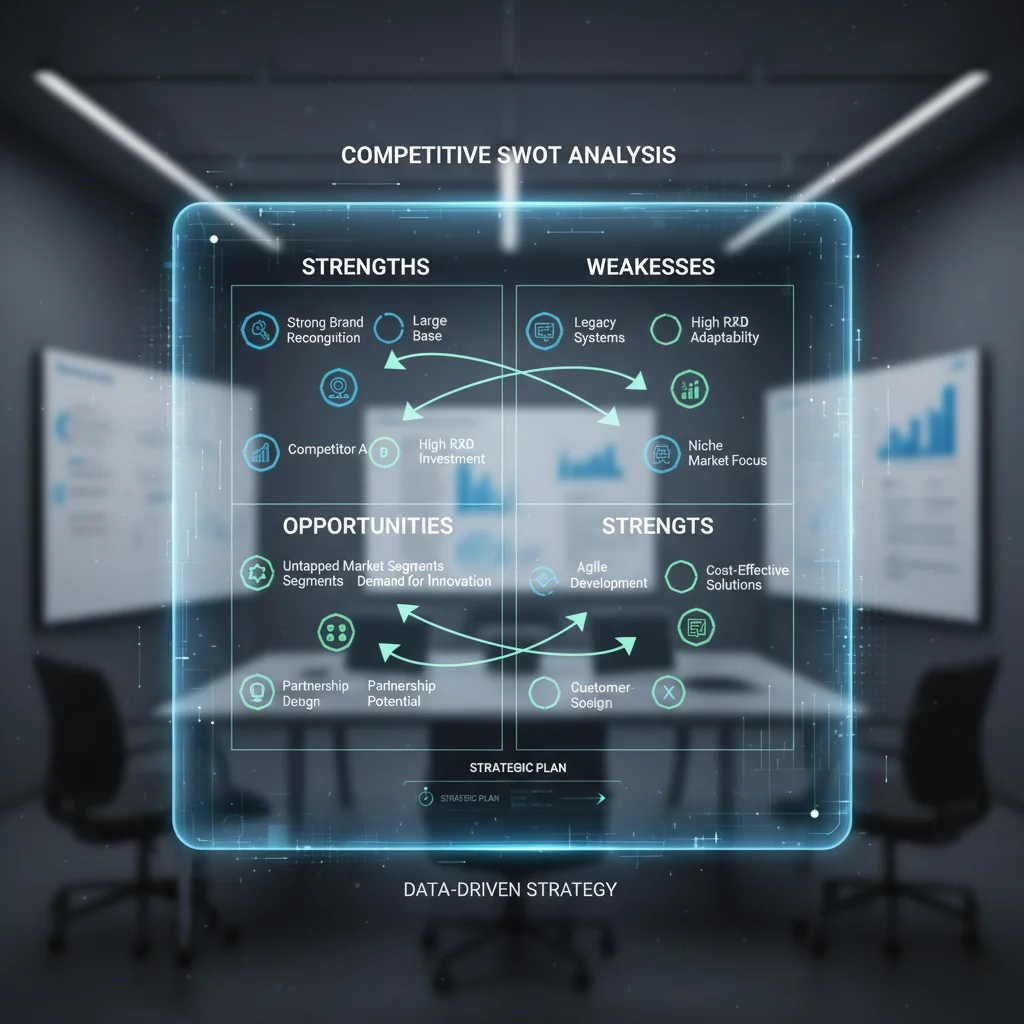
- SWOT Analysis: Evaluate competitor Strengths, Weaknesses, Opportunities, and Threats. This is a classic and highly effective method for startup competitive intelligence.
- Porter’s Five Forces: Analyze industry attractiveness and competitive intensity.
- Competitive Matrix: Create a table comparing features, pricing, target audience, and other key attributes across competitors.
- Perceptual Mapping: Visually plot competitors based on key attributes (e.g., price vs. quality) to identify positioning and gaps.
- Trend Analysis: Identify emerging patterns in competitor behavior, market shifts, or technological advancements.
Step 5: Disseminate and Act on Insights
Intelligence is useless if it’s not shared with the right people and acted upon. Establish clear channels for disseminating findings:
- Regular Reports: Create concise, actionable reports for leadership, product teams, marketing, and sales.
- Dashboards: Develop real-time dashboards to track key competitor metrics.
- Strategic Workshops: Hold sessions to discuss findings and brainstorm strategic responses.
- Integrate into Decision-Making: Ensure competitive insights are a standard input for product roadmapping, marketing campaign planning, and sales strategy.
Step 6: Continuously Monitor and Adapt
The competitive landscape is constantly evolving. Startup competitive intelligence is an ongoing process, not a one-off project. Set up alerts for competitor news, product launches, and social media mentions. Regularly review and update your competitive profiles.
Key Areas of Competitive Intelligence for US Startups
To gain that decisive 12% market advantage, US startups should focus their intelligence efforts on specific areas:
Product and Technology Intelligence
- Feature Sets: What do competitors offer? What are their unique selling points?
- Technology Stack: What technologies are they using? This can indicate scalability, innovation, or potential vulnerabilities.
- Roadmap Insights: Look for clues in job postings, patent filings, and investor presentations about their future product plans.
- User Experience (UX): How easy and intuitive are their products to use? What are common customer complaints?
Marketing and Sales Intelligence
- Messaging and Positioning: How do competitors position themselves? What value propositions do they emphasize?
- Channels and Campaigns: Where do they advertise? What content are they producing? What’s their social media strategy?
- Pricing Models: Understand their tiered pricing, discounts, and subscription models.
- Sales Process: How do their sales teams operate? What incentives do they offer?
Financial and Strategic Intelligence
- Funding Rounds and Investors: Who is funding them? This can indicate market validation and future growth potential.
- Partnerships and Acquisitions: What strategic alliances are they forming? Are they acquiring smaller companies?
- Employee Growth and Key Hires: Significant hiring in specific departments can signal new strategic directions.
- Market Share Estimates: While difficult to ascertain precisely for private companies, industry reports and analyst estimates can provide a good benchmark.
Customer Intelligence
- Customer Segments: Who are their primary customers? Are there underserved segments?
- Customer Feedback: What are customers saying in reviews, forums, and social media? What are their pain points?
- Churn Drivers: Why do customers leave competitors? This is a goldmine for improving your own offering.
Tools and Technologies for Startup Competitive Intelligence
Leveraging the right tools can significantly streamline your CI efforts:
- SEO & SEM Tools (e.g., SEMrush, Ahrefs, Moz, SpyFu): For analyzing competitor keywords, ad campaigns, organic traffic, and backlink profiles.
- Social Listening Tools (e.g., Brandwatch, Sprout Social, Mention): To monitor competitor mentions, brand sentiment, and customer discussions.
- Web Analytics Tools (e.g., SimilarWeb, Alexa): To estimate competitor website traffic, audience demographics, and traffic sources.
- CRM & Sales Intelligence Tools (e.g., Salesforce, ZoomInfo, Apollo.io): For identifying competitor sales teams, organizational structures, and potential leads.
- News & Alert Services (e.g., Google Alerts, Feedly): To stay updated on competitor news, press releases, and industry trends.
- Review Aggregators (e.g., G2, Capterra, Trustpilot): For collecting and analyzing customer reviews and feedback on competitor products.
- Patent Databases (e.g., USPTO, Google Patents): For tracking competitor intellectual property and innovation.
- Crunchbase/PitchBook: For tracking competitor funding, investors, acquisitions, and key personnel.
- Spreadsheets & BI Tools (e.g., Excel, Google Sheets, Tableau, Power BI): For organizing, analyzing, and visualizing collected data.
Common Pitfalls to Avoid in Startup Competitive Intelligence
While the benefits of startup competitive intelligence are clear, several common mistakes can derail your efforts:
- Information Overload: Collecting too much data without a clear strategy for analysis can lead to paralysis. Focus on actionable insights.
- Ethical & Legal Missteps: Never engage in illegal activities like hacking, misrepresentation, or industrial espionage. Stick to publicly available information and ethical primary research.
- Ignoring Indirect Competitors: Focusing only on direct rivals can leave you vulnerable to disruptive innovations from unexpected sources.
- Stale Data: The market moves fast. Outdated intelligence is worse than no intelligence. Ensure your data is current.
- Lack of Action: Collecting and analyzing data is only half the battle. The insights must be integrated into strategic decision-making.
- Bias: Avoid confirmation bias, where you only seek out information that confirms your existing beliefs. Be open to surprising findings.
- Underestimating Competitors: Never assume your competitors are static or incompetent. They are likely working just as hard to gain an advantage.
Case Study Snippet: How a US SaaS Startup Gained an Edge
Consider ‘InnovateFlow,’ a fictional US SaaS startup offering project management software. Initially, they struggled to differentiate themselves in a crowded market. By implementing a focused startup competitive intelligence strategy, they uncovered several key insights:
- Their top competitor, ‘TaskMaster,’ excelled in enterprise features but had significant complaints about its onboarding process and customer support for smaller teams.
- Another competitor, ‘AgilePilot,’ offered an intuitive UI but lacked robust reporting features that mid-market clients increasingly demanded.
- An emerging indirect competitor, ‘CollaborateHub,’ was gaining traction by integrating AI-driven insights, a feature InnovateFlow hadn’t prioritized.
Armed with this intelligence, InnovateFlow made strategic adjustments:
- They revamped their onboarding for SMBs, offering personalized support often missing from larger competitors.
- They accelerated the development of advanced reporting features, targeting the mid-market segment where AgilePilot was weak.
- They began exploring AI integration, recognizing its future importance.
Within 18 months, InnovateFlow reported a 15% increase in customer acquisition from SMBs and mid-market companies, directly attributable to their refined strategies based on competitive insights. This led to an estimated 10-12% increase in their relevant market share segment, demonstrating the tangible impact of effective startup competitive intelligence.

Integrating Competitive Intelligence into Your Startup Culture
For startup competitive intelligence to truly be effective, it needs to be embedded within your company’s DNA. This means:
- Leadership Buy-in: Ensure senior leadership understands and champions the value of CI.
- Cross-functional Collaboration: Encourage teams (product, marketing, sales, customer success) to share insights and collaborate on CI efforts.
- Dedicated Resources: Even if it’s not a full-time role initially, allocate specific individuals or teams to own the CI process.
- Training: Educate employees on how to ethically gather and report competitive information they encounter in their daily roles.
- Feedback Loops: Establish mechanisms for teams to provide feedback on the usefulness of CI reports and suggest new areas of focus.
The Future of Competitive Intelligence for US Startups
The landscape of competitive intelligence is constantly evolving, driven by advancements in technology and data availability. For US startups, staying ahead means embracing:
- AI and Machine Learning: AI can automate data collection, sentiment analysis, and even predict competitor moves based on historical data. This will become an increasingly powerful tool for startup competitive intelligence.
- Predictive Analytics: Moving beyond understanding ‘what happened’ to ‘what will happen’ allows for proactive strategic adjustments.
- Real-time Monitoring: The ability to track competitor activities in near real-time will provide an even faster response capability.
- Data Visualization: Making complex competitive data easily digestible through intuitive dashboards and reports will enhance decision-making.
- Ethical AI: As AI becomes more prevalent, ensuring that competitive intelligence practices remain ethical and comply with data privacy regulations will be paramount.
Conclusion: Your Startup’s Path to a 12% Market Advantage
In the dynamic and often unforgiving world of US startups, relying solely on intuition is a recipe for mediocrity. Strategic, ethical, and continuous startup competitive intelligence is the bedrock of sustainable growth and market leadership. By systematically understanding your rivals, identifying market opportunities, and adapting your strategies based on data-driven insights, your startup can not only outmaneuver competitors but also secure a significant, measurable advantage – that crucial 12% boost in market share, customer acquisition, or revenue that propels you ahead.
Start building your competitive intelligence framework today. Invest in the right tools, cultivate a culture of curiosity and strategic analysis, and transform raw data into your most powerful weapon. The future of your US startup depends on it.