Pre-Seed to Series A: Doubling Your Startup Valuation in 12 Months

Pre-Seed to Series A: Doubling Your Startup Valuation in 12 Months for US Startups
For ambitious US startups, the journey from Pre-Seed to Series A is a sprint, not a marathon. The goal? Not just to secure funding, but to significantly increase your company’s worth, ideally doubling your startup valuation growth within a tight 12-month window. This isn’t just about impressing investors; it’s about building a robust foundation, validating your market, and accelerating your path to market leadership. In today’s competitive landscape, demonstrating rapid, tangible progress is paramount. This comprehensive guide will equip you with the strategies, insights, and actionable steps necessary to achieve this ambitious goal.
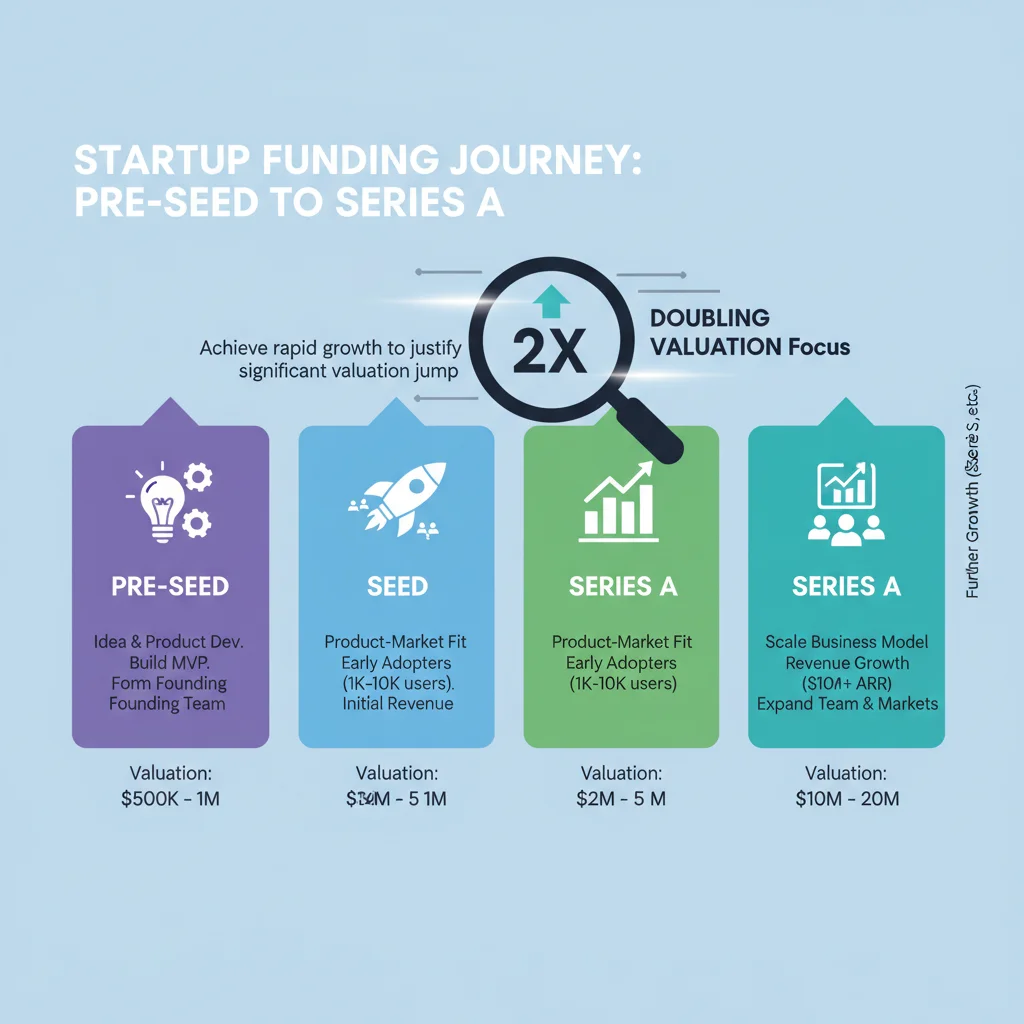
The transition from Pre-Seed to Series A represents a critical inflection point. Pre-Seed capital typically validates an idea and builds an initial prototype or MVP. Series A, on the other hand, is about proving product-market fit, demonstrating repeatable customer acquisition, and scaling operations. Doubling your startup valuation growth during this period signals strong execution, market traction, and a compelling vision for future expansion. It requires a meticulous approach to product development, market strategy, team building, and, crucially, investor relations.
Understanding the Valuation Landscape: Pre-Seed vs. Series A
Before diving into strategies, it’s crucial to understand the valuation benchmarks and expectations at each stage. Pre-Seed valuations for US startups can vary widely, often ranging from $2 million to $10 million, depending on the team, idea, and early traction. This stage is heavily reliant on the founder’s vision, experience, and the perceived size of the problem being solved. Investors at this stage are betting on the team and the potential of the idea.
Series A valuations, however, are fundamentally different. They are driven by demonstrable progress, key performance indicators (KPIs), and a clear path to scalability. Typical Series A valuations for successful US startups can range from $20 million to $50 million, or even higher for highly sought-after companies with significant traction. The jump from a $5 million Pre-Seed valuation to a $25 million Series A valuation within 12 months is an ambitious but achievable target, representing a 5x increase, well beyond merely doubling your startup valuation growth.
To bridge this gap, you need a clear understanding of what investors are looking for at each stage. At Pre-Seed, it’s about the ‘why’ and the ‘what.’ At Series A, it’s about the ‘how’ and the ‘how much.’ This shift in focus dictates the strategies you must employ to accelerate your startup valuation growth.
Key Metrics Driving Pre-Seed to Series A Valuation
To double your startup valuation growth, you must meticulously track and improve specific metrics. These are the data points that will convince Series A investors of your company’s potential:
- Product-Market Fit (PMF): This is arguably the most critical factor. It’s not just about having users; it’s about having users who *love* your product and can’t imagine living without it. Quantify PMF through high retention rates, low churn, strong engagement metrics (DAU/MAU, session length), and positive customer feedback (NPS scores).
- Customer Acquisition Cost (CAC) & Lifetime Value (LTV): Investors want to see a healthy LTV:CAC ratio (ideally 3:1 or higher), indicating that you can efficiently acquire customers who generate significant revenue over time. Demonstrate a clear, scalable, and cost-effective customer acquisition strategy.
- Revenue Growth & Unit Economics: While Pre-Seed might be light on revenue, Series A demands proof of revenue generation and strong unit economics. Show consistent month-over-month (MoM) or quarter-over-quarter (QoQ) revenue growth. Detail your gross margins and demonstrate a clear path to profitability.
- Team Strength: A strong, cohesive, and experienced team is always a critical factor. Highlight key hires made since Pre-Seed, especially those with relevant industry experience or a proven track record of scaling companies. Investors fund teams as much as ideas.
- Market Opportunity: Reiterate and refine your understanding of the total addressable market (TAM), serviceable available market (SAM), and serviceable obtainable market (SOM). Show how your product can capture a significant portion of this market and articulate your competitive advantage.
- Scalability: Can your product and business model scale efficiently? Demonstrate a clear plan for expanding your user base, product features, and operational capabilities without a proportional increase in costs.
Phase 1: Solidifying Your Foundation (Months 1-4)
The initial months post-Pre-Seed funding are crucial for laying the groundwork for rapid startup valuation growth. This phase is about execution and validating your core assumptions.
Refining Product-Market Fit
Your MVP from the Pre-Seed stage needs to evolve into a product that truly resonates with your target audience. This involves:
- Intensive User Feedback: Implement a robust system for collecting, analyzing, and acting on user feedback. Conduct user interviews, surveys, and A/B testing. Use tools to track user behavior and identify pain points and areas of delight.
- Iterative Development: Adopt agile methodologies to rapidly iterate on your product. Prioritize features that directly address user needs and contribute to core value proposition. Focus on delivering a delightful user experience.
- Defining Core Metrics: Clearly define the 3-5 key metrics that indicate product-market fit for your specific business. These might include daily active users (DAU), retention rates, conversion rates, or specific engagement actions. Track these relentlessly.
Building a High-Performing Team
Your founding team likely secured the Pre-Seed. Now, you need to expand strategically to support your planned startup valuation growth. This means:
- Strategic Hires: Identify critical gaps in your team’s expertise. This might include a Head of Product, Head of Sales/Marketing, or key engineering talent. Look for individuals with a proven track record in similar growth-stage companies.
- Culture & Values: Actively cultivate a strong company culture that aligns with your vision. A positive and productive environment attracts talent and drives performance, which is essential for sustained startup valuation growth.
- Advisory Board: Strengthen your advisory board with individuals who have deep industry connections, operational expertise, or a history of successful exits. Their guidance and network can be invaluable.
Initial Go-to-Market Strategy
Even before significant revenue, you should have a clear, testable go-to-market strategy. Experiment with different channels and messaging to identify what resonates best with your target customers. This initial validation will be key to demonstrating early traction and potential for startup valuation growth.
Phase 2: Achieving Traction and Demonstrating Scalability (Months 5-9)
With a solid foundation, these months are dedicated to proving your business model and showcasing significant traction. This is where your efforts directly impact your startup valuation growth.
Aggressive Customer Acquisition
Now is the time to pour fuel on the fire. Based on your initial go-to-market experiments:
- Scale Proven Channels: Double down on the customer acquisition channels that have shown the most promise. Optimize your campaigns for efficiency and cost-effectiveness.
- Sales & Marketing Funnel Optimization: Refine your sales and marketing funnels to minimize friction and maximize conversion rates. Implement CRM systems to track leads and customer interactions effectively.
- Data-Driven Decisions: Use analytics to continuously monitor CAC, LTV, conversion rates, and other key metrics. Make data-driven adjustments to your strategy to improve efficiency and accelerate startup valuation growth.
Revenue Generation and Unit Economics
While some Pre-Seed companies might still be pre-revenue, by the middle of this 12-month period, you need to be generating revenue and demonstrating healthy unit economics. Investors will scrutinize these numbers:
- Clear Pricing Strategy: Ensure your pricing model is well-defined, defensible, and aligned with the value you provide. Test different pricing tiers and models to optimize for revenue and customer acquisition.
- Healthy Gross Margins: Understand and optimize your gross margins. For software companies, this should ideally be above 70-80%. For hardware or service-based businesses, benchmarks will differ but profitability remains key.
- Predictable Revenue Streams: Focus on building recurring revenue (MRR/ARR) models where applicable. Predictable revenue is highly valued by Series A investors and significantly contributes to startup valuation growth.
Strategic Partnerships and Market Expansion
Look for opportunities to expand your reach and strengthen your market position through strategic partnerships. These could be with complementary businesses, distribution channels, or technology providers. Demonstrating a wider ecosystem play can significantly bolster your perceived value and contribute to startup valuation growth.
Phase 3: Preparing for Series A (Months 10-12)
The final months are dedicated to polishing your narrative, assembling your data, and engaging with potential Series A investors. This is where all your hard work culminates in a compelling story for significant startup valuation growth.
Crafting Your Investor Narrative
Your pitch deck and investor communications need to tell a compelling story of progress and future potential. This narrative should:
- Highlight Key Milestones: Clearly articulate the progress made since your Pre-Seed round. What have you achieved in terms of product development, customer acquisition, and revenue?
- Showcase Traction: Present your key metrics (PMF, LTV:CAC, revenue growth) in a clear, concise, and impressive manner. Use data visualizations to make your story impactful.
- Outline Future Vision: Articulate your grand vision for the company and how Series A funding will enable you to achieve the next set of ambitious milestones. Explain how you will continue your startup valuation growth journey.
- Market Opportunity & Competitive Advantage: Reiterate the size of the market and why your solution is uniquely positioned to win.
- Team & Advisors: Re-emphasize the strength and experience of your team and advisory board.
Financial Projections and Data Room
Investors will meticulously scrutinize your financials. Ensure you have:
- Detailed Financial Model: Develop a robust 3-5 year financial model with clear assumptions for revenue, expenses, and profitability. Be prepared to defend every assumption.
- Comprehensive Data Room: Prepare a well-organized data room with all relevant legal, financial, and operational documents. This includes cap table, incorporation documents, customer contracts, employee agreements, and detailed metric reports. A professional data room signals readiness and can expedite due diligence, supporting your startup valuation growth efforts.
Engaging with Investors
The final push involves strategic engagement with potential Series A investors:
- Targeted Outreach: Research and identify venture capital firms and angel investors who specialize in your industry, stage, and geographic location. Personalize your outreach.
- Leverage Network: Utilize your existing investor network, advisors, and mentors for warm introductions. A warm intro is significantly more effective than a cold email.
- Practice Your Pitch: Rehearse your pitch extensively. Be prepared to answer tough questions about your business, market, and financials. Confidence and clarity are key to securing the investment that fuels your startup valuation growth.
- Negotiation Strategy: Understand your company’s worth and be prepared to negotiate terms. While valuation is important, also consider the strategic value of the investor, their network, and their ability to help you grow.

Common Pitfalls to Avoid in Your Valuation Journey
While the path to doubling your startup valuation growth is clear, several common missteps can derail your efforts. Being aware of these can help you navigate the journey more smoothly:
- Lack of Focus: Trying to do too many things at once or chasing multiple market segments can diffuse your efforts and prevent you from achieving product-market fit. Focus on a core problem for a specific customer segment.
- Ignoring User Feedback: Building a product in a vacuum without constant user input is a recipe for disaster. Your users are your best source of truth.
- Poor Data Tracking: If you can’t measure your progress, you can’t demonstrate it to investors. Implement robust analytics from day one.
- Premature Scaling: Scaling customer acquisition or team size before achieving solid product-market fit and healthy unit economics can lead to burning through cash without sustainable growth.
- Weak Team Dynamics: Internal conflicts or a lack of clear roles and responsibilities can severely hamper execution and investor confidence.
- Underestimating Fundraising Time: Fundraising always takes longer than you think. Start conversations early and build relationships with investors before you desperately need the capital.
- Over-optimistic Projections: While ambition is good, unrealistic financial projections without clear, defensible assumptions will damage your credibility with investors. Be optimistic but grounded in reality.
The Role of Market Conditions and Macro Trends
It’s important to acknowledge that external factors can also influence your startup valuation growth. Macroeconomic conditions, investor sentiment, and specific industry trends play a significant role. While you cannot control these, you can:
- Stay Informed: Keep abreast of market trends, investor preferences, and economic forecasts. This knowledge will help you tailor your pitch and adjust your strategy if necessary.
- Highlight Resilience: Demonstrate how your business model is resilient to market fluctuations or how it benefits from emerging trends.
- Show Adaptability: Be prepared to pivot or adjust your strategy if market conditions shift significantly. Agility is a valuable trait for startups.
Post-Series A: Maintaining Momentum
Successfully securing your Series A round is a monumental achievement, but it’s not the finish line. It’s the starting gun for the next phase of intense startup valuation growth. The expectations from Series A investors will be even higher, demanding continued rapid execution and expansion. Your focus will shift to scaling operations, deepening market penetration, and potentially exploring new product lines or geographic markets. The discipline and strategies you employed to double your valuation from Pre-Seed to Series A will continue to be vital for your journey towards Series B and beyond.
Maintaining clear communication with your new board members and investors, delivering on promised milestones, and continuously optimizing your KPIs will be paramount. The lessons learned during this critical 12-month period will serve as a blueprint for sustained growth and value creation. Remember, every successful funding round is a validation of your progress and a commitment to your future potential, driving further startup valuation growth.
Conclusion: A Strategic Path to Exponential Value
Doubling your startup valuation growth from Pre-Seed to Series A within 12 months is an ambitious but entirely achievable goal for US startups. It requires a relentless focus on product-market fit, aggressive yet efficient customer acquisition, robust revenue generation, and strategic team building. By meticulously tracking key metrics, refining your go-to-market strategy, and preparing a compelling investor narrative, you can position your company for significant investment and accelerate your trajectory.
The journey is challenging, demanding dedication, adaptability, and a deep understanding of what drives investor confidence. However, by executing on the strategies outlined in this guide, you will not only secure crucial funding but also build a fundamentally stronger, more valuable company ready to scale. Embrace the challenge, stay data-driven, and relentlessly pursue the milestones that will propel your startup valuation growth into the stratosphere.