Employee Equity Plans: Attracting Top Talent and Driving 20% Faster Growth for US Startups in 2026

In the fiercely competitive landscape of US startups, attracting and retaining top talent isn’t just about offering competitive salaries; it’s about fostering a sense of ownership and shared destiny. This is where employee equity plans become not just beneficial, but absolutely critical. For ambitious US startups aiming for sustained growth and a significant market presence by 2026, strategically implemented employee equity plans are projected to drive up to 20% faster growth, transforming employees into true stakeholders and amplifying collective success.
The modern workforce, particularly within the innovative ecosystem of startups, seeks more than just a paycheck. They desire purpose, impact, and a direct share in the company’s triumphs. Employee equity plans fulfill this desire, aligning individual aspirations with organizational goals. This comprehensive guide delves into the intricacies of employee equity plans, exploring their various forms, benefits, and the strategic considerations necessary for their successful implementation in the US startup environment.
The Strategic Imperative of Employee Equity Plans for US Startups
For any nascent company, especially in the high-stakes world of startups, resources are often constrained. Cash compensation might be limited, making it challenging to compete with established corporations for the brightest minds. This is where employee equity plans shine as a powerful differentiator. They allow startups to offer a compelling value proposition that transcends immediate financial gratification, promising a share in future prosperity.
Beyond talent acquisition, these plans are instrumental in fostering a culture of innovation, commitment, and high performance. When employees have a vested interest in the company’s success, they are more likely to go the extra mile, think like owners, and contribute to long-term value creation. This intrinsic motivation is a potent catalyst for accelerated growth, making employee equity plans a cornerstone of any forward-thinking startup’s human capital strategy.
Understanding the "Why": Benefits Beyond Compensation
The advantages of implementing robust employee equity plans extend far beyond merely attracting talent. They create a virtuous cycle that reinforces positive organizational behaviors and outcomes:
- Attracting and Retaining Top Talent: In a competitive talent market, equity offers a significant draw, especially for individuals who believe in the startup’s vision and want to be part of its journey from the ground up. It signals confidence in future success and offers a potentially lucrative payoff.
- Aligning Employee and Company Interests: When employees own a piece of the company, their personal financial success becomes directly tied to the company’s performance. This fosters a shared sense of responsibility and encourages decisions that benefit the organization as a whole.
- Boosting Motivation and Productivity: The prospect of a significant return on their "sweat equity" can be a powerful motivator. Employees are more engaged, more productive, and more innovative when they feel like true partners in the venture.
- Fostering a Culture of Ownership: Equity instills an "owner’s mindset" throughout the organization. Employees are more proactive in identifying problems, proposing solutions, and taking initiative, leading to a more resilient and agile startup.
- Long-Term Commitment: Vesting schedules associated with equity plans encourage employees to stay with the company for extended periods, reducing turnover and ensuring continuity of knowledge and expertise.
- Capital-Efficient Compensation: Especially for early-stage startups with limited cash flow, equity allows them to offer competitive compensation packages without depleting their cash reserves, preserving capital for other critical investments.
Key Types of Employee Equity Plans for US Startups
Choosing the right type of employee equity plan is crucial and depends on various factors, including the startup’s stage, growth trajectory, and specific objectives. Here’s a breakdown of the most common types utilized by US startups:
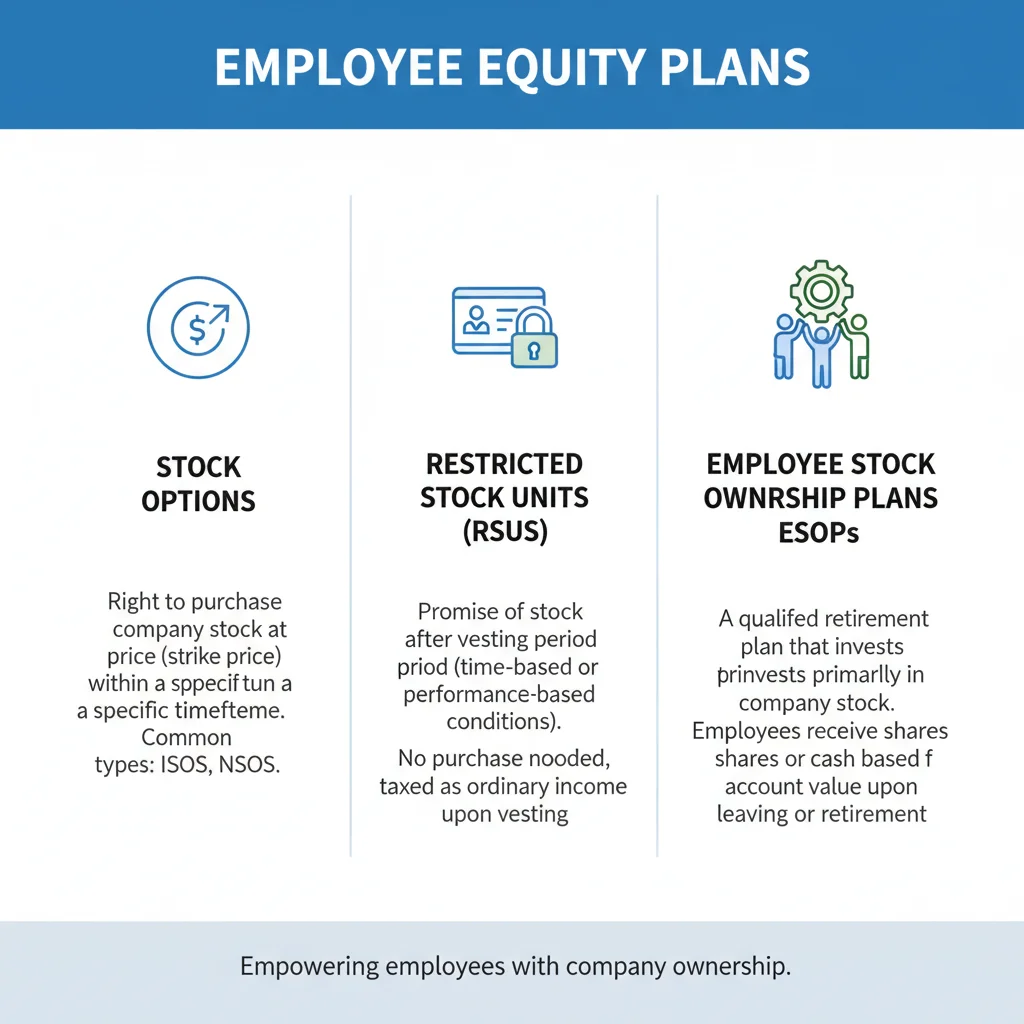
1. Stock Options
Stock options grant employees the right, but not the obligation, to purchase a specified number of company shares at a predetermined price (the "strike price" or "exercise price") within a certain timeframe. This price is typically the fair market value of the shares at the time the option is granted.
- Incentive Stock Options (ISOs): These offer favorable tax treatment for employees if certain conditions are met, primarily when the employee holds the shares for specific periods after exercise. For the company, ISOs do not result in a tax deduction.
- Non-Qualified Stock Options (NSOs): More flexible than ISOs, NSOs are taxable upon exercise (the difference between the strike price and the market price is treated as ordinary income). Companies can deduct the spread as a compensation expense.
Pros: High upside potential for employees, aligns interests with shareholders, can be a strong retention tool due to vesting. Relatively straightforward to administer compared to some other equity types.
Cons: Can be complex for employees to understand tax implications. Requires employees to "buy in" (exercise their options), which might require capital. Value can be diluted if more options are issued.
2. Restricted Stock Units (RSUs)
RSUs represent a promise from the company to grant an employee shares of company stock (or the cash equivalent) upon the satisfaction of specific vesting conditions, typically time-based or performance-based. Unlike stock options, employees don’t have to pay an exercise price.
Pros: No upfront cost for employees, simpler to understand than options, always have some value (unless the stock price drops to zero), strong retention tool due to vesting.
Cons: Less upside potential than options if the stock price skyrockets, as the "purchase price" is effectively zero. Taxable as ordinary income upon vesting.
3. Employee Stock Purchase Plans (ESPPs)
ESPPs allow employees to purchase company stock, often at a discount to the market price, through payroll deductions. These are typically offered by public companies, but some larger, pre-IPO startups might consider them as they mature.
Pros: Employees can purchase stock at a discount, encourages broad employee ownership, relatively simple for employees to participate.
Cons: Less common in early-stage startups, limited upside compared to options or RSUs if the discount is small, requires the company to be public or near-public for liquidity.
4. Employee Stock Ownership Plans (ESOPs)
ESOPs are qualified retirement plans that invest primarily in the stock of the sponsoring employer. They are typically used for broader employee ownership and can offer significant tax advantages for both the company and employees. While less common for early-stage startups due to their complexity and cost, they become a viable option as companies scale and seek broader ownership structures.
Pros: Significant tax benefits, fosters a strong ownership culture, can be used for succession planning, broad employee participation.
Cons: Complex to set up and administer, significant legal and administrative costs, less flexibility than other equity plans, not ideal for very early-stage startups.
5. Phantom Stock and Stock Appreciation Rights (SARs)
These are "synthetic equity" plans that provide employees with cash payments tied to the value of the company’s stock, without actually granting them ownership of shares. They are often used by private companies that want to avoid diluting ownership or dealing with the complexities of managing actual stock.
- Phantom Stock: Mimics actual stock ownership, with employees receiving a cash payout (or sometimes actual shares) equivalent to the value of a certain number of shares at a future date or event.
- Stock Appreciation Rights (SARs): Grant employees the right to receive a cash payment (or shares) equal to the appreciation in the company’s stock price over a specified period.
Pros: No dilution of ownership, simpler administration than actual stock plans, cash payout can be tied to liquidity events.
Cons: No actual ownership for employees, only offers cash value, potential for less psychological "ownership" compared to real shares.
Crafting the Optimal Employee Equity Plan: Key Considerations for US Startups
Designing an effective employee equity plan requires careful thought and strategic planning. It’s not a one-size-fits-all solution; what works for a seed-stage startup might not be suitable for a Series B company. Here are critical factors to consider:
1. Vesting Schedules
Vesting is the process by which an employee gains full ownership rights to their equity over time. It’s a crucial mechanism for retention and aligning long-term interests.
- Cliff Vesting: A common model where an employee receives no equity until a certain period (e.g., one year) has passed. After the "cliff," a portion of the equity vests, and the remainder vests periodically (e.g., monthly or quarterly) over the subsequent years. A typical schedule might be a one-year cliff followed by monthly vesting over the next three years.
- Graded Vesting: Equity vests gradually from the start, often on a monthly or quarterly basis, without an initial cliff.
- Performance-Based Vesting: Equity vests upon the achievement of specific milestones or performance targets, either individual or company-wide.
Strategic Tip: For startups, a one-year cliff with subsequent monthly vesting over three to four years is widely adopted. This balances employee commitment with the need for flexibility in early-stage growth.
2. Equity Pool Size and Dilution
The "equity pool" is the percentage of the company’s total shares reserved for employee equity plans. Determining the right size is a delicate balance. Too small, and it won’t be attractive; too large, and it can significantly dilute existing shareholders (founders, investors).
Typical Ranges: Early-stage startups (seed to Series A) often allocate 10-20% of their fully diluted capitalization to the employee equity pool. This percentage tends to decrease slightly in later funding rounds as the company matures.
Managing Dilution: While dilution is an inherent part of issuing equity, careful management is essential. Transparent communication with existing shareholders and realistic projections of future equity needs can mitigate concerns.
3. Valuation and Strike Price
For stock options, the "strike price" is set based on the fair market value (FMV) of the company’s common stock at the time of the grant. This typically requires a 409A valuation, an independent appraisal that determines the FMV of private company stock.
Importance of 409A: A compliant 409A valuation is critical for avoiding significant tax penalties for employees and ensuring the legitimacy of the option grants. Startups should obtain a 409A valuation annually or after significant funding rounds.
4. Tax Implications (for both Company and Employees)
The tax treatment of different equity types can be complex and varies significantly for both the company and the employee. Understanding these nuances is vital for proper planning and communication.
- ISOs vs. NSOs: As mentioned, ISOs offer potential long-term capital gains treatment for employees but no corporate deduction. NSOs are taxed as ordinary income upon exercise but allow for a corporate tax deduction.
- RSUs: Taxed as ordinary income upon vesting.
- State and Local Taxes: Beyond federal taxes, employees may face state and local income taxes on equity events, which can vary significantly by jurisdiction.
Recommendation: Always advise employees to consult with a qualified tax advisor. For the company, engage legal and financial professionals experienced in startup equity to ensure compliance and optimal structure.
5. Communication and Education
An equity plan is only as effective as its understanding. Many employees, especially those new to startups, may not fully grasp the value, risks, and complexities of equity. Clear, consistent, and transparent communication is paramount.
- Regular Education Sessions: Host workshops or webinars explaining the basics of equity, vesting, valuation, and tax implications.
- Personalized Statements: Provide employees with clear statements detailing their grants, vesting schedules, and potential value.
- FAQs and Resources: Create easily accessible internal resources (e.g., an internal wiki page) to answer common questions.
Impact: Better-informed employees are more engaged and appreciative of their equity, maximizing its motivational and retention power.
6. Legal and Administrative Overhead
Implementing and managing employee equity plans involves significant legal and administrative work, including drafting plan documents, grant agreements, managing cap tables, and ensuring compliance with securities laws (e.g., SEC regulations like Rule 701 for private companies).
Tools and Services: Utilize specialized cap table management software (e.g., Carta, EquityZen) and engage experienced legal counsel to streamline these processes and ensure compliance.
Projecting the 20% Faster Growth by 2026: The Equity Advantage
The assertion that employee equity plans can drive 20% faster growth for US startups by 2026 isn’t hyperbole; it’s a projection rooted in the cumulative effect of the benefits outlined above. Consider the following:
- Enhanced Talent Density: By attracting and retaining top-tier talent who are also incentivized as owners, startups build stronger, more capable teams. These teams are inherently more efficient and innovative, leading to faster product development, market penetration, and problem-solving.
- Increased Employee Engagement and Productivity: An ownership mindset translates directly into higher engagement. Engaged employees are known to be significantly more productive, take greater initiative, and are less prone to turnover. This sustained high performance directly impacts growth metrics.
- Improved Decision-Making: When every employee thinks like an owner, they are more likely to make decisions that prioritize the long-term health and success of the company, rather than short-term individual gains. This leads to more strategic choices and a more resilient business model.
- Reduced Turnover Costs: High employee turnover is incredibly expensive, encompassing recruitment, onboarding, and lost productivity. Equity’s retention power significantly reduces these costs, freeing up resources that can be reinvested into growth initiatives.
- Stronger Culture and Brand: Companies known for generous and transparent equity plans develop a reputation as desirable employers. This enhances their employer brand, making future talent acquisition easier and reinforcing a positive, collaborative culture that fosters innovation.
These factors, when combined, create a powerful compounding effect. A startup with a highly motivated, stable, and ownership-driven team is simply better equipped to innovate faster, execute more effectively, and capture market share at an accelerated pace compared to competitors lacking such foundational incentives. The 20% growth acceleration is a conservative estimate of this synergistic impact.

Real-World Impact and Future Trends
Numerous successful US startups, from tech giants to emerging disruptors, have leveraged employee equity plans as a cornerstone of their growth strategy. Companies like Google, Facebook, and countless others in their early stages relied heavily on equity to build their foundational teams. The stories of early employees becoming millionaires through their stock options are not just folklore; they are powerful testaments to the potential of these plans.
Evolving Landscape of Equity
As the startup ecosystem matures, so too do the approaches to equity. We are seeing trends towards:
- Increased Flexibility: More customized vesting schedules and a mix of different equity types to suit diverse employee needs and company stages.
- Secondary Markets: The rise of platforms facilitating secondary sales of private company stock offers employees earlier liquidity opportunities, making equity even more attractive for longer-tenured private company employees.
- Focus on "Total Rewards": Equity is increasingly viewed as one component of a holistic total rewards package that includes salary, benefits, culture, and professional development.
- Global Equity Considerations: As US startups expand internationally, managing equity across different legal and tax jurisdictions becomes a significant challenge and opportunity.
Conclusion: Equity as the Engine for Startup Success
For US startups eyeing aggressive growth targets by 2026, employee equity plans are not merely an HR perk; they are a fundamental strategic tool. By transforming employees into owners, these plans unlock unparalleled levels of motivation, commitment, and innovation. They enable startups to compete for and secure the best talent, foster a resilient ownership culture, and ultimately, drive significantly faster growth.
The journey of implementing and managing equity is complex, requiring careful consideration of legal, financial, and human capital aspects. However, the investment in time and resources pales in comparison to the potential returns: a highly engaged workforce, aligned interests, and a direct pathway to achieving and exceeding ambitious growth projections. As the startup world continues to evolve, the power of employee equity remains an undeniable force for success, propelling companies towards their vision with a shared sense of purpose and prosperity.