
In the vibrant, yet often cutthroat, landscape of the US startup ecosystem, the path from a nascent idea to a successful enterprise is fraught with critical decisions. One of the most pivotal choices entrepreneurs face revolves around funding: how to fuel growth without sacrificing significant equity too early. This article delves into the powerful strategy of Bootstrapping Sustainable Growth, charting a course for startups to reach the coveted Series B funding round with minimal early dilution.
The allure of venture capital is undeniable. Large sums of money can accelerate product development, expand market reach, and attract top talent. However, this acceleration often comes at a steep price: significant equity dilution in early rounds. For many founders, maintaining a substantial stake in their company is not just about financial gain, but about retaining control and preserving the original vision. This is where the art and science of Bootstrapping Sustainable Growth shine, offering an alternative, often more resilient, trajectory.
The Core Philosophy of Bootstrapping: Building from Within
Bootstrapping, at its heart, is about self-reliance. It means funding your startup primarily through personal savings, early customer revenue, and efficient resource management, rather than external investment. This approach forces a discipline that often eludes heavily funded startups. Every dollar spent is scrutinized, every hire is critical, and every feature developed must directly contribute to revenue or validated market need. This lean operating model is not just a temporary measure; it’s a foundational philosophy that cultivates resilience and strategic thinking.
Why Bootstrapping Matters for Long-Term Value
The primary benefit of extended bootstrapping is the preservation of equity. Each funding round involves selling a portion of your company. The earlier and more frequently you raise external capital, the smaller your ownership stake becomes. By delaying significant external investment until later stages, when your valuation is substantially higher due to proven product-market fit, revenue, and growth, you sell a smaller percentage for a much larger sum. This strategy directly contributes to maximizing founder and early employee wealth in the long run.
Moreover, Bootstrapping Sustainable Growth fosters a deep understanding of your business’s economics. When cash flow is king, you learn precisely what drives revenue, where costs can be optimized, and how to achieve profitability. This operational rigor is an invaluable asset that prepares a company for the increased scrutiny and expectations of Series B investors.
Navigating the US Market: Unique Challenges and Opportunities
The US market presents both unique challenges and unparalleled opportunities for bootstrapped startups. On one hand, it’s highly competitive, with a strong venture capital culture that can make self-funded companies feel like outliers. On the other hand, the vast market size, robust infrastructure, and access to talent offer immense potential for organic expansion.
Competitive Landscape and Investor Expectations
US investors, particularly at the Series A and B stages, often look for companies that have demonstrated rapid growth and a clear path to market leadership. While bootstrapped companies might not always show the hyper-growth curves of their VC-backed counterparts in the earliest stages, they can demonstrate something equally compelling: capital efficiency, profitability, and a deeply loyal customer base. These metrics signal a healthy, resilient business model that can withstand economic fluctuations and achieve sustainable profitability.
Leveraging US Resources for Organic Growth
Despite the VC dominance, the US offers numerous avenues for organic growth. Access to a skilled workforce, innovative technological infrastructure, and a culture of entrepreneurship can be leveraged. Focusing on strong product-market fit, exceptional customer service, and word-of-mouth marketing can create powerful growth loops without significant capital injections. Furthermore, the availability of robust SaaS tools and cloud infrastructure allows bootstrapped companies to operate efficiently at scale, minimizing operational overheads.
Strategic Pillars for Bootstrapping to Series B
Achieving Series B funding through a bootstrapped model requires a deliberate and strategic approach. It’s not just about avoiding investors; it’s about building a company so strong and self-sufficient that investors will clamor to be a part of its future, on your terms.
1. Obsessive Focus on Product-Market Fit
Before seeking significant external capital, a bootstrapped company must unequivocally prove its product-market fit. This means having a product that solves a real problem for a defined customer segment, and those customers are willing to pay for it. Customer feedback, iteration, and a relentless pursuit of value creation are paramount. Without a strong product, no amount of funding will guarantee success. This focus on product excellence is a hallmark of Bootstrapping Sustainable Growth.
2. Revenue Generation and Profitability from Day One (or Soon After)
Unlike many VC-backed startups that might prioritize user acquisition over revenue in early stages, bootstrapped companies must prioritize revenue. The sooner you generate income, the sooner you become self-sufficient. Aim for profitability as early as possible. Positive cash flow is the lifeblood of a bootstrapped business, enabling reinvestment into growth initiatives without external dependence. This financial discipline builds a solid foundation for future scalability.
3. Lean Operations and Frugal Innovation
Every expense must be justified. Bootstrapped companies excel at finding creative, cost-effective solutions to problems. This might involve leveraging open-source tools, outsourcing non-core functions, or adopting a remote-first work model to reduce overhead. Frugal innovation isn’t about being cheap; it’s about being resourceful and making every dollar count, a key principle for Bootstrapping Sustainable Growth.
4. Strategic Customer Acquisition and Retention
Organic growth channels are crucial. Content marketing, SEO, social media engagement, and referral programs can be highly effective without requiring massive ad budgets. Focus on building a loyal customer base through exceptional product quality and customer service. High customer retention not only guarantees recurring revenue but also serves as a powerful testament to your product’s value when speaking with future investors.
5. Building a Strong, Resilient Team
Even without deep pockets, you can attract top talent by offering compelling vision, a strong culture, and the potential for significant equity upside in a less diluted company. Bootstrapped environments often foster a sense of ownership and camaraderie that can be incredibly motivating. Hiring strategically and ensuring each team member adds significant value is critical.
The Journey to Series B: What Investors Look For
By the time a bootstrapped company considers Series B, it should be a well-oiled machine. Investors at this stage are not looking for ideas or potential; they are looking for proven traction, significant market opportunity, and a clear path to scale. 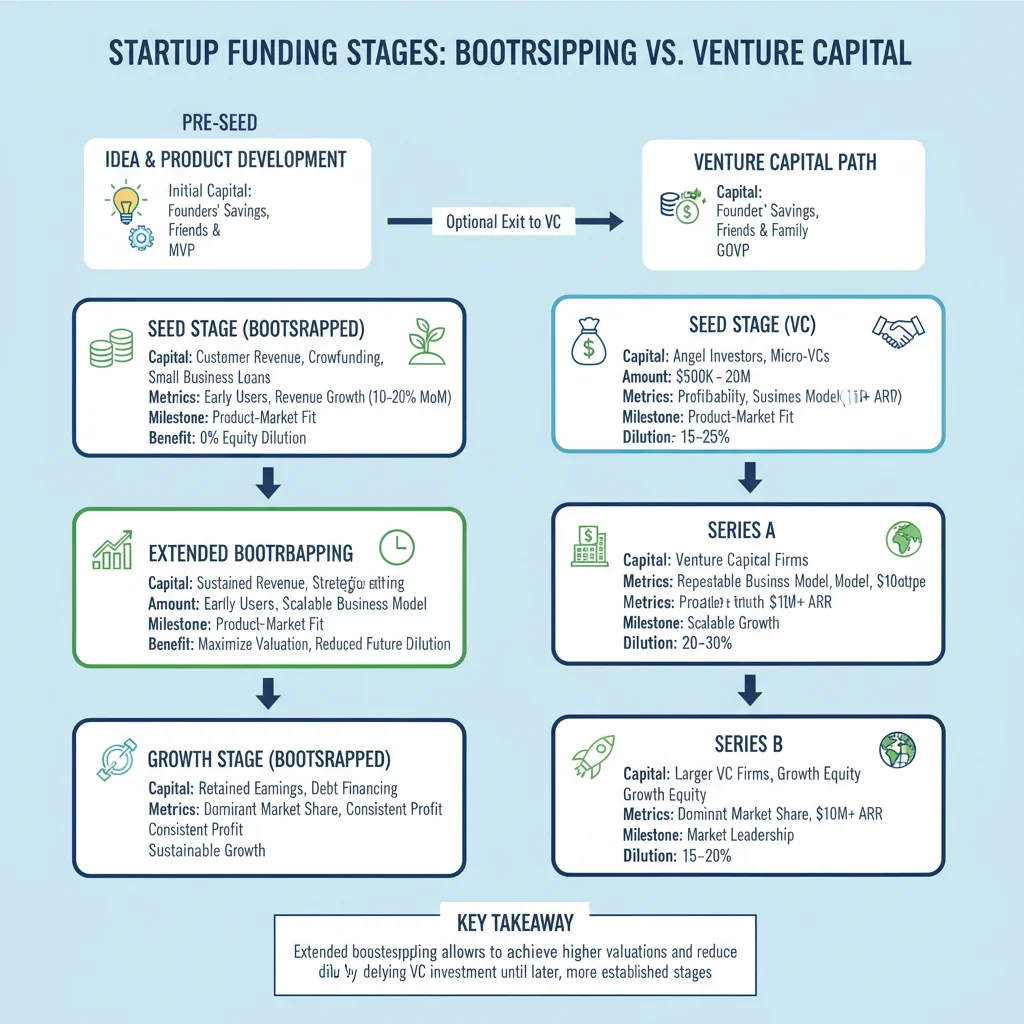
Key Metrics and Milestones for Series B
- Substantial Revenue: Typically, companies raising Series B will have annual recurring revenue (ARR) in the range of $5M to $15M, with strong growth rates.
- Proven Business Model: A clear, repeatable, and scalable business model that has demonstrated profitability or a clear path to it.
- Market Leadership: Evidence of gaining significant market share or establishing a strong competitive advantage in a large, growing market.
- Strong Unit Economics: Demonstrably positive customer lifetime value (LTV) to customer acquisition cost (CAC) ratios, indicating efficient growth.
- Scalable Operations: The ability to handle increased demand and expand without disproportionate increases in cost.
- Experienced Management Team: A leadership team with a proven track record of execution and strategic vision.
When you approach Series B with these metrics, you are negotiating from a position of strength. You are not desperate for capital; you are seeking strategic partners to accelerate an already successful trajectory. This significantly reduces the likelihood of excessive dilution and allows you to dictate more favorable terms.
Preparing for the Funding Round: A Strategic Approach
Even after successfully bootstrapping, the Series B funding round requires meticulous preparation. This isn’t just about financial numbers; it’s about narrative, vision, and strategic alignment.
Crafting Your Story: The Bootstrapped Advantage
Your bootstrapped journey is a powerful narrative. It demonstrates resilience, resourcefulness, financial discipline, and a deep understanding of your customers and market. Frame your story around how Bootstrapping Sustainable Growth has led to a more robust, capital-efficient, and ultimately more valuable company. Highlight how this approach has allowed you to build a product that truly resonates with users and a business model that stands on its own two feet.
Due Diligence Readiness
Investors will conduct extensive due diligence. Ensure all your financial records are impeccable, legal documentation is in order, and business metrics are accurately tracked and easily verifiable. Having a clean house makes the process smoother and instills confidence in potential investors.
Identifying the Right Partners
Not all venture capitalists are created equal. Seek out firms and individual partners who understand and appreciate the bootstrapped journey. Look for investors who bring more than just capital – strategic guidance, network connections, and expertise in scaling companies at your stage. A good Series B investor will be a true partner, not just a financier.
Post-Series B: Sustaining Momentum and Avoiding Pitfalls
Securing Series B is a significant milestone, but it’s not the finish line. Maintaining the discipline learned during bootstrapping is crucial to avoid common pitfalls that can derail even well-funded companies.
Maintaining Financial Discipline
The influx of capital can sometimes lead to a relaxation of financial discipline. It’s vital to remember the lessons learned from Bootstrapping Sustainable Growth. Continue to monitor burn rate, optimize costs, and seek efficiency wherever possible. The goal is to use the Series B capital to accelerate growth in a strategic, rather than reckless, manner.
Scaling Responsibly
Rapid scaling can introduce new complexities. Ensure your infrastructure, processes, and team are equipped to handle increased demand. Prioritize building a strong leadership team and empowering employees. Avoid growing for growth’s sake; each expansion should be strategic and contribute to long-term value.
Protecting Your Culture
The lean, resilient culture forged during the bootstrapping phase is a valuable asset. As you grow and bring in new team members, actively work to preserve these core values. A strong culture can be a significant differentiator and a key driver of employee retention and productivity.
Case Studies and Examples of Bootstrapped Success
Numerous companies have successfully leveraged the principles of Bootstrapping Sustainable Growth to achieve significant valuations and impact. Basecamp (formerly 37signals) is a classic example, famously self-funded for many years before taking a small, strategic investment. Mailchimp, a dominant email marketing platform, also famously bootstrapped to immense success before its eventual acquisition by Intuit for $12 billion. These companies demonstrate that an alternative path exists, and it can lead to extraordinary outcomes.
Their stories underscore the power of focusing on customer value, building a profitable business model, and resisting the pressure for premature external funding. They prove that you can build a category-leading company while retaining significant ownership and control, making the eventual Series B a celebration of success rather than a desperate lifeline.

The Future of Funding: A Hybrid Approach
While this article champions extended bootstrapping, it’s important to recognize that the funding landscape is evolving. Many companies now adopt a hybrid approach, combining strategic self-funding with smaller, targeted angel or seed rounds that provide critical capital without excessive dilution. The key is to be intentional about every dollar raised and to ensure that external capital genuinely accelerates growth in a way that aligns with your long-term vision and equity preservation goals.
The decision to raise external capital should always be a strategic one, driven by a clear need and a well-defined plan for how that capital will generate a significant return and increase the company’s valuation. For companies committed to Bootstrapping Sustainable Growth, Series B becomes an opportunity to supercharge an already thriving business, rather than a make-or-break moment.
Conclusion: The Power of Strategic Self-Sufficiency
Bootstrapping to Series B in the US market is not merely a funding strategy; it’s a philosophy of building a robust, resilient, and valuable company from the ground up. By prioritizing product-market fit, revenue generation, lean operations, and strategic growth, entrepreneurs can navigate the competitive landscape with minimal early dilution.
This approach empowers founders to retain control, maximize their equity, and build a business with a deeply ingrained financial discipline. When the time comes for Series B, the bootstrapped company stands as a testament to sustainable success, attracting investors who recognize and value a strong, self-sufficient enterprise. The journey of Bootstrapping Sustainable Growth is challenging, but the rewards – both financial and in terms of ownership and control – are profoundly impactful, setting the stage for long-term prosperity in the dynamic US market.