Achieving Product-Market Fit: 30% User Retention in 6 Months for US Startups

Achieving Product-Market Fit: 30% User Retention in 6 Months for US Startups
In the dynamic and hyper-competitive landscape of US startups, the quest for sustainable growth is paramount. While flashy launches and significant funding rounds often capture headlines, the true bedrock of a successful venture lies in a concept that’s far less glamorous but infinitely more crucial: product-market fit. For US startups, achieving a robust product-market fit isn’t just a goal; it’s a survival imperative. More specifically, aiming for a 30% user retention rate within the first six months of launch is often considered a strong indicator that you’re on the right track. This comprehensive guide will delve into what product-market fit truly means, why 30% user retention is a critical benchmark, and how US startups can strategically navigate the path to achieving both by 2026.
Understanding Product-Market Fit: The Holy Grail for Startups
Marc Andreessen, co-founder of Andreessen Horowitz, famously defined product-market fit as being in a good market with a product that can satisfy that market. It sounds simple, yet its attainment is notoriously difficult. It’s the moment when your product truly resonates with a significant segment of your target audience, solving a real problem for them in a way that generates sustained demand and usage. Without product-market fit, even the most innovative ideas or well-funded startups are destined to struggle, burning through capital without gaining traction.
Why is Product-Market Fit So Crucial for US Startups?
For US startups, the stakes are particularly high. The market is saturated, investor expectations are soaring, and competition is fierce. Achieving product-market fit means:
- Sustainable Growth: Instead of constantly chasing new users, your existing users become advocates, driving organic growth through word-of-mouth and referrals.
- Reduced Churn: Users who find genuine value in your product are less likely to leave, leading to higher retention rates.
- Efficient Marketing: When your product truly fits the market, marketing efforts become more effective and less costly.
- Investor Confidence: Demonstrating strong product-market fit, especially through metrics like user retention, signals to investors that your business model is viable and scalable.
- Clear Product Roadmap: Understanding what your market truly values allows for more focused and impactful product development.
The 30% User Retention Benchmark: A Six-Month Sprint for US Startups
User retention is arguably the most telling metric for whether a startup has achieved product-market fit. It measures the percentage of users who return to use your product over a specific period. For US startups, a 30% user retention rate within six months is often cited as a strong early indicator of product-market fit, particularly for consumer-facing apps or SaaS products. While this number can vary by industry and business model, it serves as a powerful target.
Why 30%? The Significance of This Metric
A 30% retention rate within six months suggests several positive signals:
- Value Proposition Clarity: Users understand and derive consistent value from your product.
- Habit Formation: The product has successfully integrated into users’ routines or workflows.
- Problem-Solving Efficacy: Your product is effectively addressing a pain point or fulfilling a need.
- Early Engagement: It indicates that your initial user acquisition efforts are bringing in the right audience.
- Foundation for Growth: A solid base of retained users provides a stable platform for future expansion and monetization.
Falling significantly below this benchmark within the critical six-month window often signals a lack of product-market fit, requiring a strategic pivot or significant product iteration. Conversely, exceeding it can indicate a rapidly growing, highly sticky product.
Phase 1: Defining Your Target Market and Problem Space (Months 1-2)
Before you can achieve product-market fit, you must first understand the market you’re trying to fit into. This initial phase is about rigorous research and validation.
1. Deep Dive into Market Research
- Identify Your Niche: Don’t try to be everything to everyone. For US startups, narrowing down your target demographic, psychographics, and specific use cases is crucial. Who are your ideal customers? What are their demographics, behaviors, and motivations?
- Market Size & Trends: Is the market large enough to sustain your business? Are there emerging trends that validate your product idea? Tools like Google Trends, Statista, and industry reports can be invaluable.
- Competitor Analysis: Who are your direct and indirect competitors? What are their strengths and weaknesses? How can your product differentiate itself?
2. Problem Validation: Are You Solving a Real Problem?
- Customer Interviews: Conduct extensive qualitative interviews with potential users. Ask open-ended questions about their pain points, current solutions, and desired outcomes. Listen more than you talk.
- Surveys & Focus Groups: Gather quantitative data to validate the prevalence and severity of the identified problems.
- Empathy Mapping: Create detailed empathy maps to truly understand your users’ thoughts, feelings, sayings, and doings related to the problem you’re addressing.
3. Crafting Your Unique Value Proposition (UVP)
Based on your research, articulate a clear and compelling UVP. What makes your product different and better than existing alternatives? Why should a user choose you? Your UVP should directly address the validated pain points of your target market. This clarity is fundamental to achieving product-market fit.
Phase 2: Building and Iterating Your Minimum Viable Product (MVP) (Months 2-4)
With a clear understanding of your market and problem, the next step is to build an MVP that can be tested and iterated upon rapidly. This phase is crucial for moving towards product-market fit.
1. Define Your Core Features
An MVP is not a stripped-down version of your final product; it’s the smallest possible product that delivers core value and solves the primary problem for your target users. Focus on the essential features that will prove or disprove your core hypothesis. Avoid feature creep.
2. Agile Development & Rapid Prototyping
- Build Fast, Learn Faster: Utilize agile methodologies to develop your MVP. Short sprints, continuous feedback loops, and iterative development are key.
- User Experience (UX) First: Even with an MVP, the user experience must be intuitive and delightful. A clunky MVP will deter users regardless of its problem-solving potential.
3. Early User Testing & Feedback Loops
- Beta Programs: Launch a closed beta with a small, carefully selected group of early adopters. These users are often more forgiving and willing to provide detailed feedback.
- Usability Testing: Observe users interacting with your product. Identify friction points, confusing elements, and areas for improvement.
- Structured Feedback: Implement mechanisms for collecting feedback, such as in-app surveys, feedback forms, and direct communication channels.
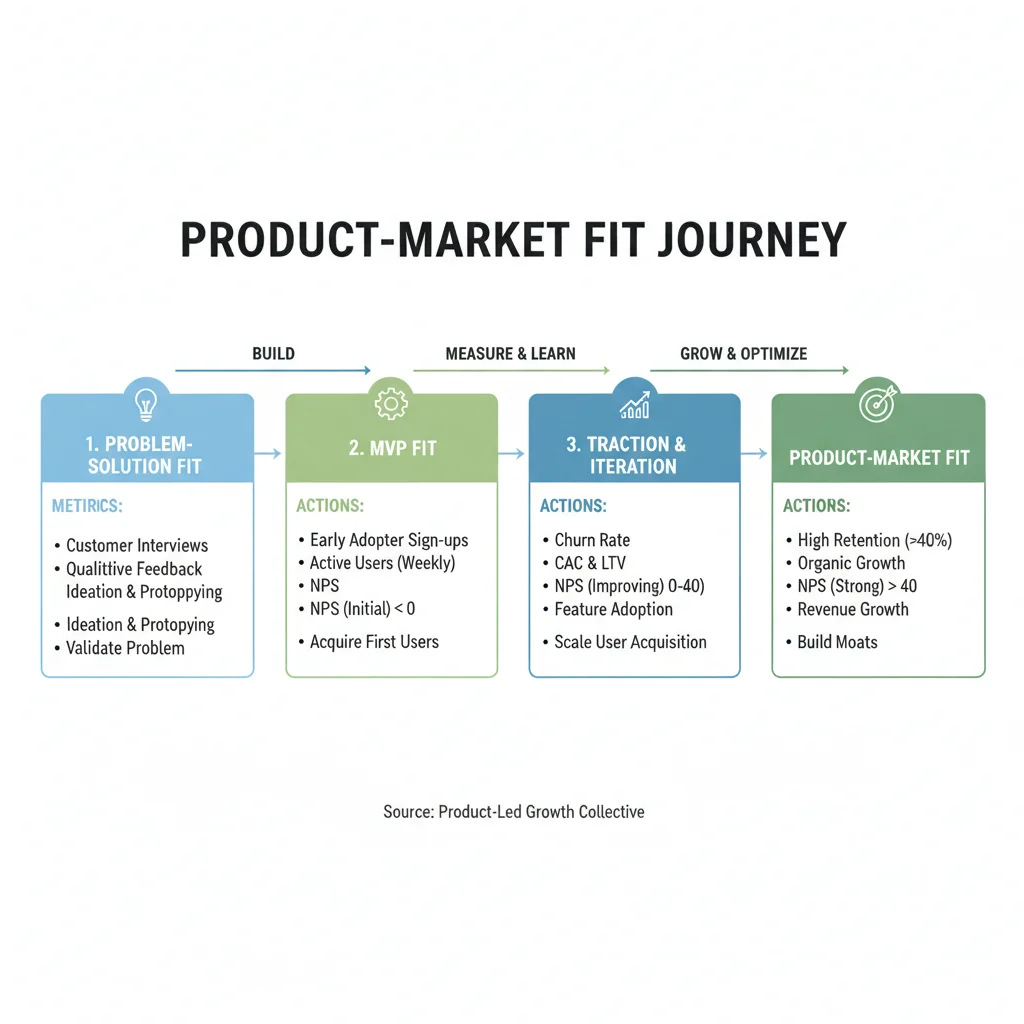
Phase 3: Measuring and Optimizing for 30% User Retention (Months 4-6)
This is where the rubber meets the road. With your MVP in the hands of users, your focus shifts to rigorous measurement, analysis, and optimization to hit that 30% retention target and truly achieve product-market fit.
1. Key Metrics for Product-Market Fit & Retention
Beyond the overall 30% retention rate, several other metrics are crucial:
- Cohort Analysis: Track retention by cohorts (groups of users who joined at the same time). This helps identify if recent changes are improving or hurting retention.
- Engagement Metrics: Daily Active Users (DAU), Weekly Active Users (WAU), Monthly Active Users (MAU), average session length, features used, and frequency of use. These tell you how users are interacting with your product.
- Net Promoter Score (NPS): A measure of customer loyalty and satisfaction. High NPS often correlates with strong retention.
- Customer Lifetime Value (CLTV): While a longer-term metric, early indicators of CLTV can show the potential value of retained users.
- Churn Rate: The inverse of retention. Understanding why users churn is as important as understanding why they stay.
2. The Power of Qualitative Feedback for Product-Market Fit
While quantitative data tells you what is happening, qualitative feedback tells you why. This is invaluable for refining your product-market fit.
- Exit Surveys & Interviews: When users churn, try to understand their reasons. What didn’t they like? What were they expecting?
- Customer Support Interactions: Your support team is on the front lines. Analyze common questions, complaints, and feature requests.
- User Community Engagement: If applicable, monitor forums, social media, and other community channels for sentiment and feedback.
3. Iteration and Optimization: The Continuous Loop
Achieving product-market fit is not a one-time event; it’s a continuous process of learning and adapting. Based on your data and feedback:
- Feature Prioritization: Double down on features that drive engagement and retention. Consider deprecating or redesigning features that are rarely used.
- A/B Testing: Test different onboarding flows, UI elements, and messaging to see what resonates best with users.
- Personalization: Can you tailor the user experience to make it more relevant and valuable for individual users?
- Communication Strategy: How are you communicating product updates, new features, and value to your users? Effective communication can significantly impact retention.
Strategies for Boosting User Retention for US Startups
To hit that 30% retention target within six months, US startups need proactive strategies:
1. Flawless Onboarding Experience
The first few interactions with your product are critical. A smooth, intuitive, and value-driven onboarding process can dramatically increase the likelihood of a user returning. Guide users to their first ‘aha!’ moment quickly.
2. Consistent Value Delivery
Users will only stick around if your product consistently delivers on its promise. This means regular updates, bug fixes, and continuous improvement based on user needs. Never stop striving for better product-market fit.
3. Proactive Customer Support
Excellent customer support can turn frustrated users into loyal advocates. Be responsive, empathetic, and proactive in addressing user issues and questions.
4. Engagement Beyond the Product
- Email Marketing: Send personalized emails with tips, new features, and relevant content.
- Push Notifications: Use sparingly and strategically to re-engage users with valuable information or calls to action.
- Community Building: Foster a sense of community around your product, allowing users to connect, share ideas, and help each other.
5. Feedback Integration
Actively demonstrate to your users that their feedback is valued. Communicate how their suggestions have led to product improvements. This builds trust and loyalty, reinforcing your product-market fit.

Real-World Examples of Product-Market Fit Success (US Startups)
Many successful US startups have achieved significant retention rates by focusing intensely on product-market fit. Consider:
- Slack: Initially a gaming company, their internal communication tool became their main product. They found immense product-market fit by solving a critical pain point for teams: fragmented communication. Their early retention was incredibly high due to the immediate value provided.
- Zoom: While not a new concept, Zoom perfected the video conferencing experience during a time of increasing remote work. Their ease of use, reliability, and free tier created a strong product-market fit, leading to explosive growth and high retention.
- Stripe: By simplifying online payments for developers with elegant APIs, Stripe addressed a significant market need that existing solutions failed to meet. Their focus on the developer experience led to strong adoption and loyalty among their target audience.
These examples highlight that product-market fit is often about identifying an underserved need or solving an existing problem in a significantly better way.
Common Pitfalls to Avoid on the Path to Product-Market Fit
For US startups, the journey to product-market fit is fraught with challenges. Avoiding these common mistakes can save valuable time and resources:
- Building in a Vacuum: Developing a product without continuous user feedback is a recipe for disaster. Your assumptions about what users want are rarely 100% accurate.
- Ignoring Early Signals: Don’t dismiss low retention rates or negative feedback. These are crucial indicators that your product isn’t resonating.
- Chasing Vanity Metrics: Focus on actionable metrics like retention and engagement, not just downloads or sign-ups.
- Lack of Focus: Trying to solve too many problems for too many people dilutes your value proposition and makes it harder to achieve deep product-market fit in any single niche.
- Premature Scaling: Investing heavily in marketing and sales before achieving product-market fit will lead to high customer acquisition costs and high churn.
The Future of Product-Market Fit for US Startups in 2026
As we look towards 2026, the landscape for US startups will continue to evolve. The emphasis on product-market fit will only intensify, with new trends shaping its attainment:
- AI and Personalization: Leveraging AI to deeply understand user behavior and offer hyper-personalized experiences will be key to driving retention.
- Community-Led Growth: Building strong, engaged user communities will become an even more powerful driver of product-market fit and organic growth.
- Ethical AI & Data Privacy: Users will increasingly demand transparency and control over their data. Startups that prioritize ethical data practices will build greater trust and loyalty.
- Sustainability and Impact: Products that align with users’ values regarding sustainability and social impact may find stronger resonance and deeper engagement.
- Web3 & Decentralization: Emerging technologies like Web3 could redefine how users interact with products and ownership, opening new avenues for achieving product-market fit in decentralized ecosystems.
US startups that can adapt to these shifts, while maintaining a relentless focus on solving real user problems and delivering consistent value, will be best positioned to achieve and sustain strong product-market fit.
Conclusion: Your Roadmap to 30% Retention and Product-Market Fit
For US startups aiming for long-term success, achieving product-market fit is not an option; it’s a necessity. The ambitious goal of 30% user retention within six months serves as a powerful performance indicator, signaling that your product is truly resonating with its target audience. This journey demands a strategic, data-driven approach, starting with deep market understanding, followed by agile MVP development, and continuous iteration based on rigorous measurement and qualitative feedback.
By focusing on a flawless onboarding experience, consistent value delivery, proactive customer support, and strategic engagement, US startups can significantly increase their chances of hitting this crucial retention benchmark. Remember, product-market fit is an ongoing process, requiring constant vigilance and adaptation to market changes and user needs. Embrace the feedback, iterate relentlessly, and build a product that your users truly can’t live without. Your future success as a US startup depends on it.