Federal Grants 2026: Secure Up to $1M for Small Businesses in Emerging Industries

Unlocking Federal Grants: A 2026 Guide to Securing Up to $1 Million for Small Businesses in Emerging Industries (FINANCIAL IMPACT)
The landscape of small business funding is constantly evolving, and for entrepreneurs in emerging industries, 2026 presents an unprecedented opportunity to tap into significant federal grants. These grants, often reaching up to $1 million, are not just financial injections; they are catalysts for innovation, job creation, and economic growth. Navigating the complex world of federal funding can be daunting, but with the right knowledge and strategic approach, your small business can secure the capital needed to thrive. This comprehensive guide will illuminate the path to successfully acquiring Federal Grants 2026, specifically tailored for businesses at the forefront of new and innovative sectors.
Emerging industries, by their very nature, are characterized by rapid development, high potential for disruption, and often, significant upfront investment. Whether you’re in artificial intelligence, renewable energy, biotechnology, advanced manufacturing, or sustainable agriculture, the U.S. government recognizes the critical role these sectors play in national competitiveness and societal well-being. Consequently, various federal agencies allocate substantial budgets to support research, development, commercialization, and expansion within these fields. Understanding where to look, how to apply, and what makes a compelling proposal is paramount to unlocking these lucrative opportunities.
Why Federal Grants Are a Game-Changer for Emerging Industries
For small businesses, especially startups and those in nascent industries, traditional funding avenues like bank loans or venture capital can be challenging to access. This is often due to perceived high risk, lack of collateral, or insufficient operating history. Federal grants offer a vital alternative, providing non-dilutive capital – meaning you don’t have to give up equity in your company. This is a crucial advantage, allowing founders to maintain full ownership and control while still fueling their growth.
Key Benefits of Securing Federal Grants:
- Non-Dilutive Funding: As mentioned, this is perhaps the most significant advantage. Unlike equity investments, grants do not require you to surrender ownership or control of your business.
- Validation and Credibility: Receiving a federal grant serves as a powerful endorsement of your business’s potential, technology, or mission. It signals to investors, partners, and customers that your innovation has been vetted and deemed worthy by a rigorous federal review process.
- Access to Resources: Beyond the financial award, many grant programs offer access to federal laboratories, technical assistance, mentorship, and networking opportunities that can be invaluable for emerging businesses.
- Stimulus for R&D: Federal grants are often specifically designed to fund research and development, allowing small businesses to push the boundaries of innovation without immediate pressure for commercial returns.
- Enhanced Reputation: Being a federal grant recipient can significantly boost your company’s reputation and attractiveness for future funding rounds, partnerships, and talent acquisition.
The strategic pursuit of Federal Grants 2026 can therefore be a transformative experience for small businesses, providing not just financial stability but also a launchpad for exponential growth and impact.
Identifying Relevant Federal Grant Opportunities for 2026
The first step in securing federal funding is knowing where to look. The U.S. government offers thousands of grant programs across various agencies, each with specific objectives, eligibility criteria, and funding priorities. For emerging industries, certain programs and agencies are particularly relevant.
Key Agencies and Programs to Monitor:
- Small Business Innovation Research (SBIR) and Small Business Technology Transfer (STTR) Programs: Often referred to as ‘America’s Seed Fund,’ SBIR/STTR programs are dedicated to stimulating technological innovation by small businesses. Eleven federal agencies participate, including:
- Department of Defense (DoD)
- National Institutes of Health (NIH)
- National Science Foundation (NSF)
- Department of Energy (DOE)
- National Aeronautics and Space Administration (NASA)
- Department of Agriculture (USDA)
- Department of Commerce (DOC)
- Department of Education (ED)
- Department of Homeland Security (DHS)
- Department of Transportation (DOT)
- Environmental Protection Agency (EPA)
- Department of Energy (DOE): Beyond SBIR/STTR, the DOE offers substantial grants for clean energy technologies, advanced materials, energy efficiency, and renewable energy projects. These are crucial for businesses in the sustainable tech sector.
- National Science Foundation (NSF): The NSF supports fundamental research and education in all non-medical fields of science and engineering. Many emerging technologies have their roots in basic scientific discovery, making NSF grants highly relevant for early-stage innovation.
- National Institutes of Health (NIH): For biotech, health tech, and medical device companies, NIH grants are a primary funding source, supporting research from basic science to clinical trials.
- Department of Defense (DoD): The DoD funds a vast array of technologies with military applications, which often have dual-use potential for commercial markets. This includes AI, cybersecurity, advanced materials, and robotics.
- Department of Agriculture (USDA): For businesses in sustainable agriculture, food technology, and biobased products, the USDA offers grants to support research, development, and rural economic development.
These programs typically have three phases. Phase I grants are for feasibility studies and proof-of-concept, often ranging from $50,000 to $250,000. Phase II grants fund principal R&D efforts over one to two years, frequently reaching up to $1 million or more. Phase III is for commercialization, often without direct federal funding but with assistance in securing private sector funding or non-SBIR/STTR federal contracts.
Where to Find 2026 Grant Solicitations:
- Grants.gov: This is the central federal website for finding and applying for federal grants. You can search by keyword, agency, and eligibility. It’s essential to create an account and regularly check for new solicitations relevant to your industry.
- Agency-Specific Websites: Each federal agency maintains its own grants page, often providing more detailed information and resources. For example, the SBIR.gov website is a dedicated portal for SBIR/STTR opportunities.
- Newsletters and Mailing Lists: Subscribe to newsletters from relevant federal agencies, industry associations, and grant consulting firms to stay informed about upcoming solicitations and deadlines.
- Grant Consulting Firms: While they come with a cost, experienced grant consultants can help identify suitable opportunities and streamline the application process, especially for complex Federal Grants 2026.
Understanding the Federal Grant Application Process (FINANCIAL IMPACT)
The application process for federal grants is rigorous and time-consuming, but the potential financial impact of securing up to $1 million makes it well worth the effort. It typically involves several stages, each requiring meticulous attention to detail.
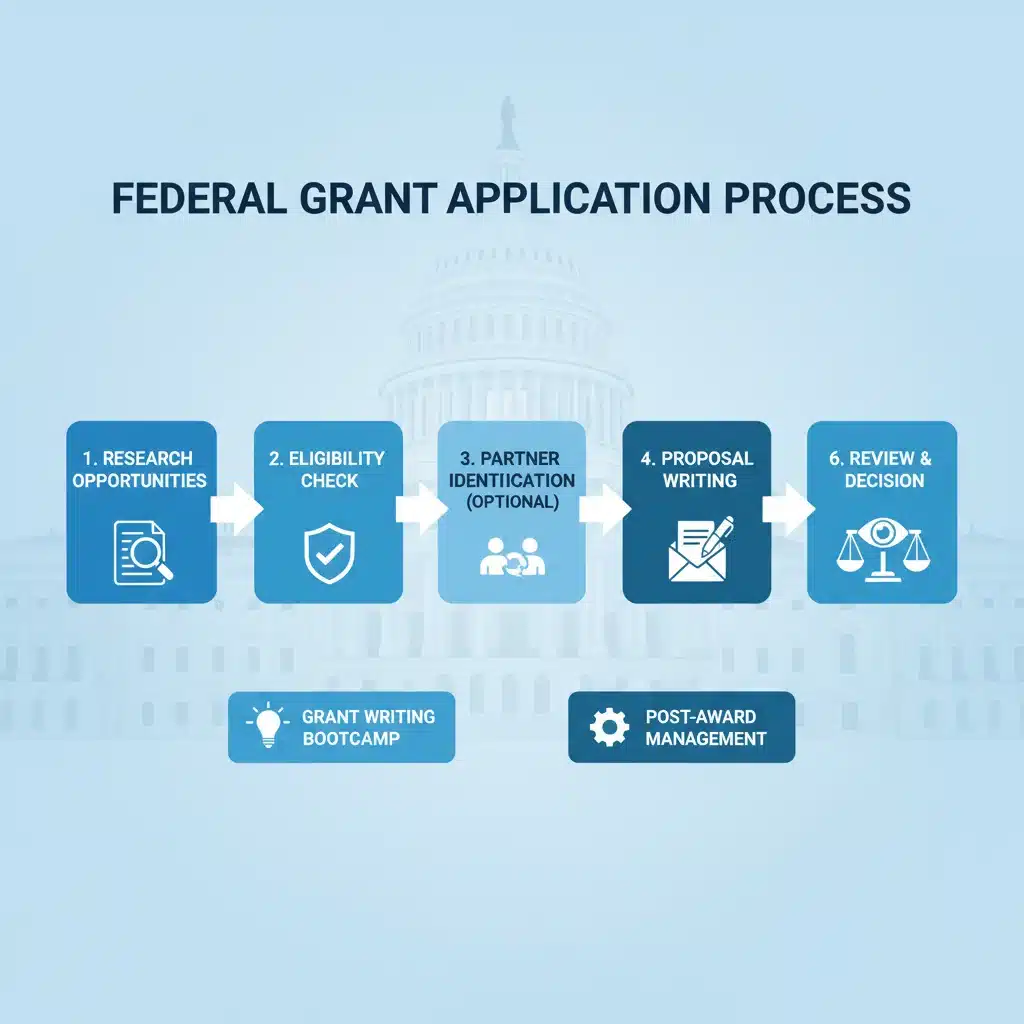
Key Steps in the Application Journey:
- Registration and Preparation: Before you can even apply, your business needs to be registered with several federal systems. This includes obtaining a Unique Entity Identifier (UEI) from SAM.gov, registering with SAM.gov itself (System for Award Management), and creating an account on Grants.gov. This process can take several weeks, so start early!
- Thorough Research and Eligibility Check: Once you identify a promising grant opportunity (often called a ‘solicitation,’ ‘Funding Opportunity Announcement’ (FOA), or ‘Program Announcement’ (PA)), carefully read the entire document. Pay close attention to:
- Eligibility Criteria: Does your business meet the size standards, ownership requirements, and industry focus?
- Scope of Work: Does your proposed project align perfectly with the grant’s objectives and technical requirements?
- Funding Amount and Duration: Is the requested amount justifiable within the grant’s limits?
- Required Deliverables: What reports, milestones, and outcomes are expected?
- Review Criteria: This is crucial. Understand how your proposal will be evaluated.
- Developing a Compelling Proposal: This is the heart of your application. A strong proposal clearly articulates your project’s innovation, feasibility, and potential impact. It typically includes:
- Abstract/Summary: A concise overview of your project.
- Introduction/Background: Contextualize the problem you’re solving and the current state of technology.
- Technical Approach: Detail your methodology, experimental design, and anticipated results. Show a clear path from concept to commercialization.
- Team Qualifications: Highlight the expertise and experience of your team relevant to the project.
- Budget Justification: Provide a detailed and realistic breakdown of how you will use the requested funds. Every dollar must be justified.
- Commercialization Plan: For many grants, especially SBIR/STTR Phase II, demonstrating a viable path to market and significant commercial potential is critical.
- Letters of Support: These can significantly strengthen your application, demonstrating interest from potential customers, partners, or end-users.
- Budgeting for Success: A well-crafted budget is essential. It should be realistic, transparent, and align with the proposed work. Federal grants often have specific rules regarding allowable costs (e.g., personnel, equipment, travel, indirect costs). Understanding and adhering to these guidelines is vital to avoid delays or disqualification.
- Submission: Most federal grant applications are submitted electronically through Grants.gov. Ensure all required documents are correctly formatted and uploaded before the deadline. Technical glitches can occur, so do not wait until the last minute.
- Review and Follow-up: After submission, your proposal will undergo a rigorous peer review process. This can take several months. If your application is successful, you will receive an award notification. If not, agencies often provide feedback, which can be invaluable for future applications.
Crafting a Winning Grant Proposal for 2026
Securing Federal Grants 2026 up to $1 million requires more than just a good idea; it demands a meticulously planned and expertly written proposal. Reviewers are looking for clarity, innovation, feasibility, and impact.
Tips for a Standout Proposal:
- Start Early: Grant writing is not a last-minute task. Give yourself ample time (at least 2-3 months) to research, write, review, and revise.
- Read the Solicitation Carefully (Again!): Every word in the Funding Opportunity Announcement matters. Address every single requirement, even the seemingly minor ones.
- Align with Agency Mission: Demonstrate how your project contributes to the specific mission and strategic goals of the funding agency.
- Highlight Innovation: Clearly articulate what makes your technology or approach novel and how it advances the state of the art.
- Strong Team: Showcase the qualifications and relevant experience of your principal investigator (PI) and key personnel.
- Feasibility and Risk Mitigation: Convince reviewers that your project is technically feasible and that you have a plan to address potential challenges.
- Quantify Impact: Whenever possible, use data and metrics to describe the potential economic, social, or scientific impact of your project.
- Clear and Concise Writing: Avoid jargon where possible, and explain complex concepts simply. Use headings, bullet points, and visuals to improve readability.
- Proofread Meticulously: Typos, grammatical errors, and formatting inconsistencies can detract from the professionalism of your proposal. Have multiple people review it.
- Seek Feedback: Before submission, get feedback from mentors, colleagues, or grant writing professionals.
Remember, the goal is to make it easy for the reviewers to understand your vision and see the value in funding your project. A well-structured and persuasive proposal is your best advocate.
Key Emerging Industries Targeted by Federal Grants in 2026
While federal grants are diverse, certain emerging industries are consistently prioritized due to their strategic importance for national security, economic competitiveness, and societal well-being. Keeping an eye on these sectors will help you focus your search for Federal Grants 2026.
Industries with High Grant Potential:
- Artificial Intelligence (AI) and Machine Learning (ML): From advanced algorithms to AI applications in healthcare, defense, and manufacturing, this sector continues to receive substantial federal investment.
- Biotechnology and Life Sciences: Research into new therapies, diagnostics, genetic engineering, and sustainable bio-products.
- Renewable Energy and Clean Technology: Solar, wind, geothermal, energy storage, smart grids, and carbon capture technologies.
- Advanced Manufacturing: Robotics, automation, additive manufacturing (3D printing), and smart factory solutions.
- Quantum Computing and Information Science: Cutting-edge research into quantum technologies that promise revolutionary advancements in computing and cryptography.
- Cybersecurity: Protecting critical infrastructure, data privacy, and national security in an increasingly digital world.
- Space Exploration and Commercial Space: New technologies for space travel, satellite communications, and resource utilization.
- Sustainable Agriculture and Food Technology: Innovations in crop yields, precision agriculture, alternative proteins, and food waste reduction.
- Advanced Materials: Development of novel materials with superior properties for various applications, from aerospace to consumer goods.
Staying abreast of federal priorities and national strategic initiatives will give your small business a significant advantage in identifying and successfully applying for relevant Federal Grants 2026.
Managing Your Grant Award and Compliance
Congratulations! You’ve secured a federal grant. However, the journey doesn’t end with the award notification. Federal grants come with significant responsibilities regarding financial management, reporting, and compliance. Proper grant management is crucial to ensure continued funding and maintain a good standing with federal agencies.

Key Aspects of Grant Management:
- Financial Tracking: Maintain meticulous records of all expenditures, ensuring they align with your approved budget. Use accounting software capable of tracking grant funds separately.
- Reporting Requirements: Federal grants typically require regular financial and technical reports. These reports must be submitted on time and accurately represent your progress and expenditures. Failure to comply can lead to suspension of funds or future ineligibility.
- Compliance with Regulations: Understand and adhere to all federal regulations, such as the Uniform Administrative Requirements, Cost Principles, and Audit Requirements for Federal Awards (2 CFR Part 200, often referred to as ‘Uniform Guidance’).
- Audits: Be prepared for potential audits. Federal agencies may conduct financial or programmatic audits to ensure compliance and proper use of funds.
- Intellectual Property (IP): Understand the terms related to intellectual property generated under the grant. While small businesses generally retain IP rights under SBIR/STTR, specific clauses may apply.
- Communication with the Agency: Maintain open and transparent communication with your assigned grant officer or program manager. Notify them promptly of any significant changes to your project or budget.
Effective grant management is not just about avoiding penalties; it’s about building a reputation as a reliable and responsible recipient of federal funds, which can open doors for additional Federal Grants 2026 and beyond.
Common Pitfalls and How to Avoid Them
While the prospect of securing up to $1 million in federal funding is exciting, many businesses encounter common challenges. Being aware of these pitfalls can help you navigate the process more smoothly.
Avoid These Mistakes:
- Ignoring Eligibility Criteria: Applying for grants you don’t qualify for wastes time and resources.
- Late Submissions: Federal deadlines are strict, with no exceptions.
- Generic Proposals: Tailor each proposal specifically to the solicitation. A one-size-fits-all approach rarely works.
- Unrealistic Budgets: Propose a budget that is both justified and achievable within the grant’s scope and duration.
- Lack of Technical Detail: Reviewers need to understand the scientific or technical merit of your project.
- Poor Writing and Formatting: A poorly written or formatted proposal is difficult to read and can create a negative impression.
- Underestimating Time Commitment: Grant writing is a significant undertaking. Allocate sufficient time and resources.
- Neglecting Commercialization: For many grants, the potential for market impact is as important as the scientific innovation.
- Inadequate SAM.gov Registration: Ensure your SAM.gov registration is active and up-to-date, as it can expire annually.
Conclusion: Your Path to Securing Federal Grants in 2026
For small businesses in emerging industries, Federal Grants 2026 represent a powerful mechanism for growth, innovation, and achieving significant financial impact. The opportunity to secure up to $1 million in non-dilutive funding can be a game-changer, propelling your business forward without sacrificing equity.
While the application process is demanding, a strategic approach, thorough preparation, and a commitment to detail will significantly increase your chances of success. By understanding the landscape of federal funding, identifying relevant opportunities, crafting compelling proposals, and diligently managing awards, your small business can unlock a wealth of resources designed to foster innovation and contribute to the nation’s economic and technological advancement.
Start your research today, leverage available resources, and position your small business to seize the incredible opportunities presented by federal grants in 2026. The future of your emerging industry depends on bold ideas and the funding to bring them to fruition.